For centuries, one family has been safeguarding an ancient library in Mauritania
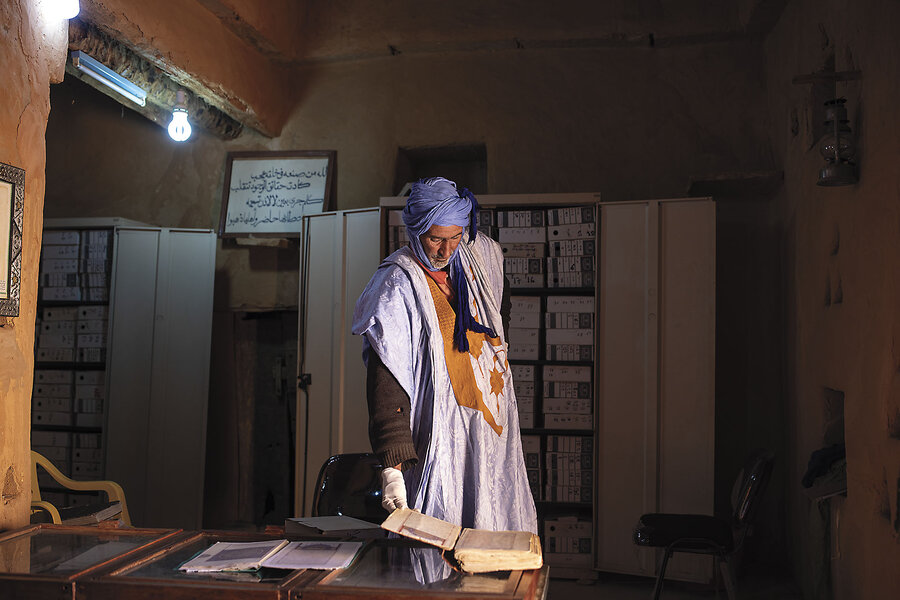
Mohammed Abdullah Ould Gholam Habott is responsible for taking care of more than 1,400 manuscripts at the Habott Library, one of only a few family-run libraries still active in Chinguetti.
Standing in the cool, dry air of the stone library that he has safeguarded for almost half his life, Mohammed Abdullah Ould Gholam Habott recounts how male ancestors in his family cobbled together their collection over three centuries. To purchase Moorish texts, for example, his great-grandfather traveled all the way from the isolated Mauritanian desert city of Chinguetti to Andalusia, an autonomous community in southern Spain.
Mr. Habott is responsible for taking care of more than 1,400 manuscripts at the Habott Library, one of only a few family-run libraries still active in Chinguetti. The manuscripts are among the oldest in West Africa. Many are religious texts, including interpretations of the Quran, but others deal with astrology, grammar, and language.
Mr. Habott has revered the role of library custodian since childhood; he was weaned on stories about his forebears and the library’s visitors.
The manuscripts at the Habott Library are among the oldest in West Africa. A historian says family-run libraries like this one were born out of Chinguetti’s role as a caravan and pilgrimage hub on trans-Saharan routes, en route to Timbuktu in Mali or to Mecca in Saudi Arabia.
“Over the years, I’ve seen all the different situations the library has faced,” Mr. Habott says. “When there were waves of visitors, and also none.”
The European researchers who make the trek, he notes, are always interested in names of books and their age – those kinds of facts. “But Arab researchers are more interested in the meaning of these texts,” he says.
As per custom in Chinguetti, Mr. Habott was selected as safekeeper of the family library in 2002 at the annual meeting where the entire family gathers to discuss both family and library matters.
David Kyule, a lecturer in the University of Nairobi’s Department of History and Archeology, describes the libraries of Chinguetti as archives of lived history. “They are not just isolated manuscripts but repositories of community memory and identity,” he says. “Families in Chinguetti have traditionally owned and passed down these collections, a practice archaeologists describe as part of the social fabric of the region’s historical learning culture.”
The historian says that these libraries were born out of Chinguetti’s role as a caravan and pilgrimage hub on trans-Saharan routes, en route to Timbuktu in Mali or to Mecca in Saudi Arabia.
“Caravans and scholars brought and copied texts; families kept these collections over centuries, preserving this intellectual legacy in harsh desert conditions,” he says. “[They are] tangible proof that knowledge production, literacy, and scholarly exchange flourished in the Sahara long before European colonialism.”
Deepen your worldview with Monitor Highlights.
Politics with respect Get political stories with respectful analysis.
There‘s a world of new ideas in every Books newsletter.
There‘s more to life, enrich yours with Culture & Learning weekly.
Follow humanity‘s discoveries with Science & Nature stories in your inbox.
Gain a spiritual perspective from the stories in your inbox.
Want to understand the deeper impact of critical events? Learn the Monitor‘s insight.
Considering Chinguetti’s remoteness, it faces the same problem that many small villages all over the world do: What will happen when younger generations leave? The libraries in Chinguetti are always owned by a male relative, because if women marry, it will break the family chain of custody.
Mr. Habott, who is in his early 50s, has two adolescent sons and is not sure what will happen if they seek fortunes beyond Chinguetti. “I’ve always felt proud to be part of something bigger than myself,” he says. “I hope one of my sons will feel the same.”
Monitor journalism changes lives because we open that too-small box that most people think they live in. We believe news can and should expand a sense of identity and possibility beyond narrow conventional expectations.
Our work isn't possible without your support.