How a fusion start-up could help maintain the U.S. nuclear arsenal
A new Albuquerque mixed-use neighborhood called Mesa del Sol, near the airport, is still under construction. But it’s coming together: earth-toned homes have popped up; rock-based snake sculptures line the medians. There’s also a road called Pacific Fusion Drive—and it now leads toward a construction site where a company of the same name broke ground on a $1-billion fusion research and manufacturing campus on a hot, dusty August day.
The bigwigs in attendance—New Mexico’s governor and senators, Albuquerque’s mayor, and leaders from the nuclear establishment, among others—escaped the heat and dust inside a fancy air-conditioned tent with a carpeted floor. They spent the morning talking about what Pacific Fusion could do for New Mexico, the clean-energy sector and nuclear-weapons research.
Early in the day’s events, National Nuclear Security Administration head Brandon Williams stepped up to the mic, two pieces of heavy machinery holding a U.S. flag behind him. “I represent the NNSA,” he said. “We’re about 70 percent of the budget of the Department of Energy. Let me just tell you, the NNSA is not sending anybody to Mars, and we’re not reading your text messages.” It was not to be confused, in other words, with NASA or the National Security Agency.
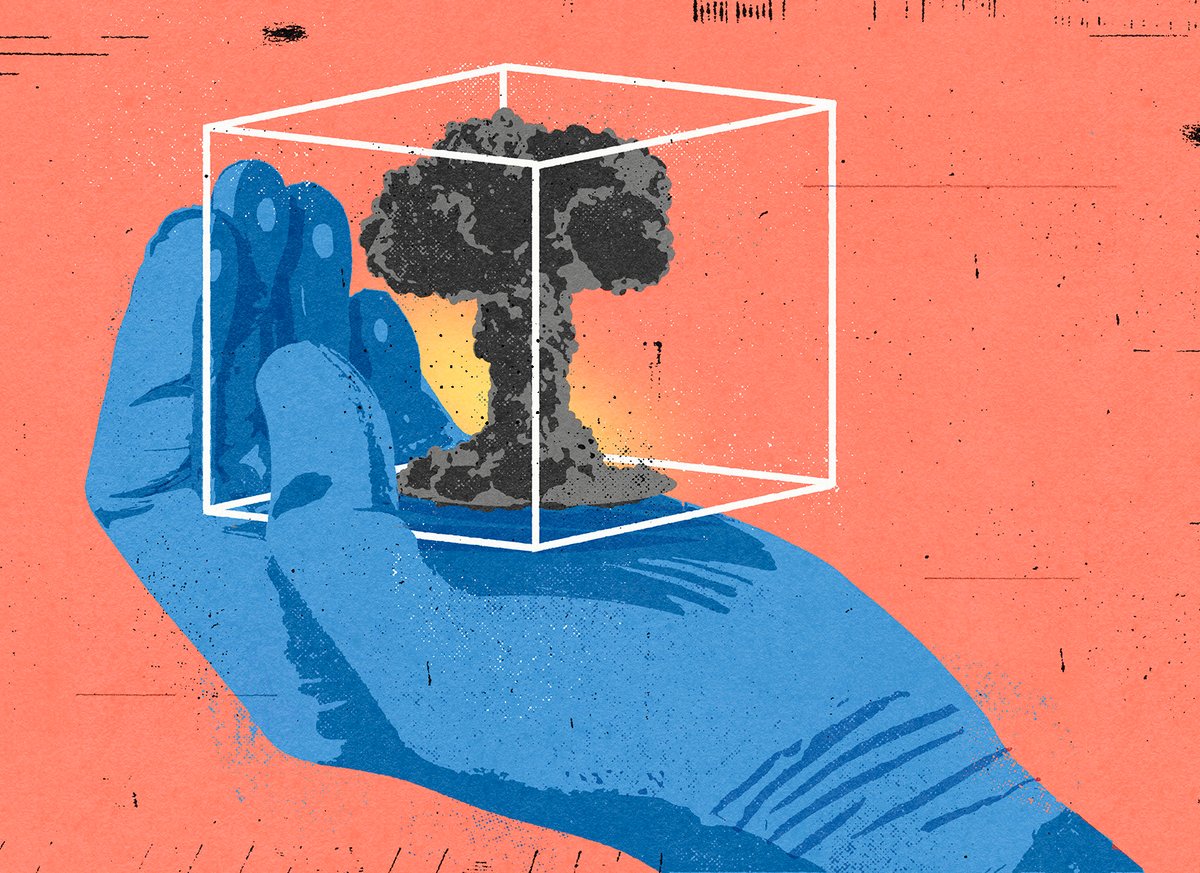
The NNSA maintains and is currently modernizing the U.S.’s nuclear stockpile. The U.S. hasn’t blown up a nuclear weapon in an explosive test since 1992. Instead weapons scientists rely on smaller-scale experiments and sophisticated simulations to understand how the weapons should behave. Now, under a public-private partnership agreement with Pacific Fusion, some of that nuclear-security work could happen at a commercial fusion facility.
At national laboratories such as Sandia, Lawrence Livermore and Los Alamos, scientists use enormous machines—for instance, a Sandia fusion facility called the Z Machine, just a few miles from that eerily cool and undusty tent, and the National Ignition Facility (NIF) at Lawrence Livermore in California—to mimic aspects of bombs. The results help scientists keep nuclear weapons safe and functional without having to set one off.
The co-founder of Pacific Fusion, Keith LeChien, used to work at both those labs and on those machines. While there, he saw a way to improve on their technology: do fusion bigger, better and more efficiently. He started Pacific Fusion to build that idea out.
According to the memorandum of understanding (MOU) that Williams was there to sign on behalf of the federal government, some nuclear-security research may take place at Pacific Fusion’s future facility. “It’s the foundation of investment from our national labs and our government that makes today possible,” Williams said to the audience. He called up LeChien so he, too, could sign. “You go first,” Williams said. “Give me a second to back out.” People looking on, some still munching on mini quiche and green-chile breakfast potatoes, laughed.
Publicly, Pacific Fusion talks mostly about its future ability to supply electricity, a promise the fusion industry has made for years. But the technology is also useful for national security, and those applications don’t require the same level of power-generating fusion success that the electrical grid does. “With atomic science, there will always be dual use, and that is also true for what Pacific Fusion wants to do,” Williams told me in a cozy media-only section of the event.
In modern nuclear weapons, conventional explosives set off a fission reaction—the splitting of big atoms—whose intensity then ignites a fusion reaction that combines light atoms. Understanding exactly how fusion works, in the grittiest detail, is therefore of extreme interest to nuclear-weapons scientists. So, too, is the way objects react when a fusion reaction booms nearby. Can, say, a circuit board that’s essential to one nuke survive the detonation of another, nearby nuke? “Systems have to be able to withstand high pressure, high temperature, all with energy released in just a very short time,” Sandia director Laura McGill said during a panel on Pacific Fusion’s defense applications.
Figuring out whether those systems can survive is a big part of what Sandia’s Z Machine and Lawrence Livermore’s NIF were built for. They are both “pulsed-power” instruments: they store, compress and release a huge amount of energy in a short period, sending it toward a tiny container of fusion fuel. That pulse crushes the fuel, driving its atoms to unite and release their own huge amount of energy, whose nature and effects scientists can study.
LeChien and many Pacific Fusion employees have been on the government side of this work (Los Alamos’s director Thom Mason, for instance, told me he first heard of the company when it started hiring his staff). LeChien started working on the Z Machine as an intern in 2001. He went on to NNSA headquarters, where he ran a fusion program that oversaw Z and NIF, and then he moved to Livermore. During his time working at these federal entities, he co-invented a piece of equipment, the impedance-matched Marx generator, that could potentially improve their fusion-igniting processes.
At Z, storing up the initial charge takes a few minutes, and the energy pulse then has to be temporarily compressed several times so that when it smashes against the fuel, it packs a huge, quick punch. Pacific Fusion’s system, at least in theory, charges on the scale of seconds and then requires only one compression.
The company hopes that on the very ground where the fancy tent flapped, it can demonstrate a fusion reaction that releases more energy than goes into it, an achievement called net facility gain. It’s something that hasn’t ever actually been achieved. Pacific Fusion also aims to create a fusion reaction an order of magnitude more powerful than those at the national lab facilities. This process, which it calls “high yield,” “has interesting use cases for different defense applications,” LeChien says.
NNSA is being encouraged to pursue partnerships like this one. Other parts of government already contract out rocket launches, cloud storage, satellite intelligence and artificial-intelligence analysis to the tech sector. “We don’t move fast enough, and we don’t possess all of the innovation,” Williams says of his agency. “We do provide a fantastic foundation, but we really need the innovation of private industry to move things quickly.” And that’s important right now, he adds, because China is fast building up its fusion capabilities.
For now, much of this work is still hypothetical; Pacific Fusion’s campus, of which the demonstration facility is part, is currently under construction at the end of Pacific Fusion Drive.
Near the end of the event in August, ceremonial shovels stuck into the earth shone in the sun behind Williams. “What you’re seeing today in this MOU is an acknowledgment that the foundational work of atomic science is no longer exclusively the purview of a state government,” he said. “There’s a first-place prize for deterrence: first place is freedom and prosperity. And there’s a second-place prize for deterrence. It’s called annihilation and subjugation.”