Why data centers are reviving solid-state transformers
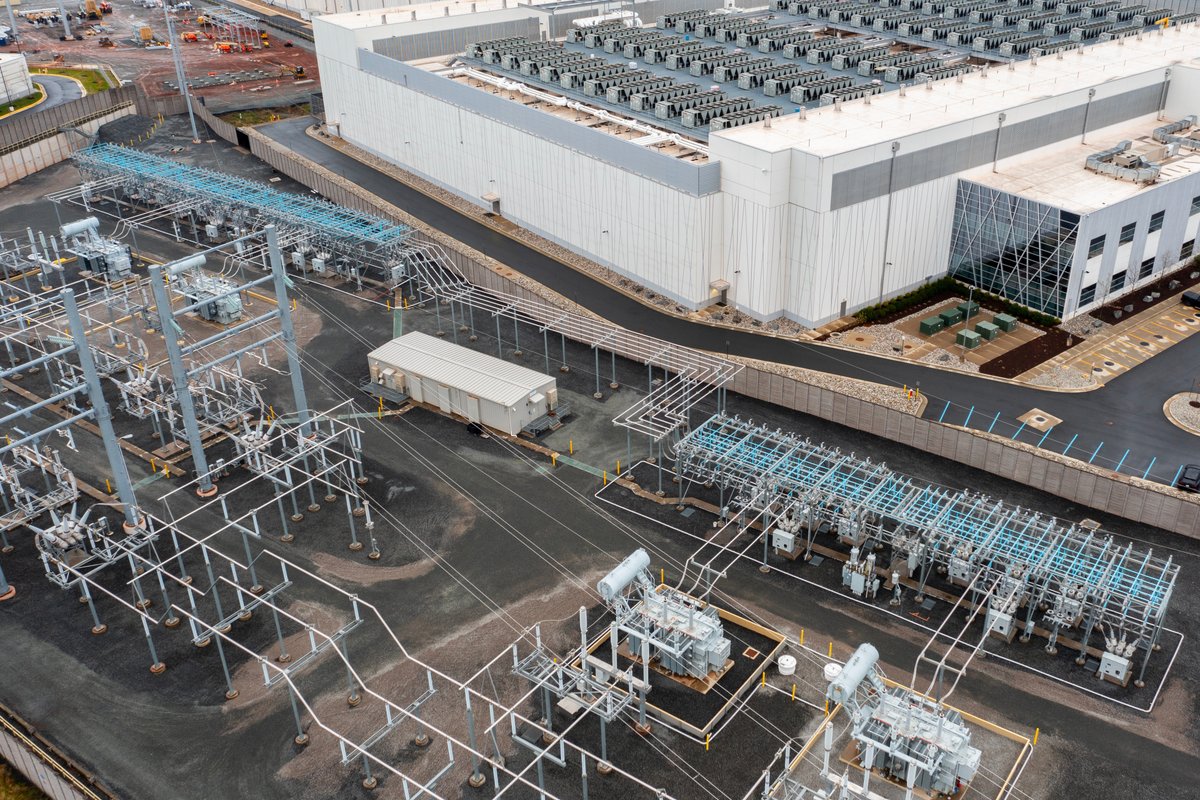
On a humid morning in June, Ramadan Elmoudi nervously watched grid current flow into a machine his colleagues had spent years building and kept his expectations low. Years earlier, a similar test by another group of researchers left their machine smoking, two days in a row. This time nothing burned. “I was stunned,” says Elmoudi, a senior research engineer at the New York Power Authority.
The humming metal box, installed at a research substation in the wooded hills of western Massachusetts, looked like a large refrigerator, indistinguishable from much of the electrical gear around it. But inside was a solid-state transformer, or SST—an array of power electronics that was meant to do the work of several pieces of that gear—and hopefully much more. Now the researchers, from a laboratory at North Carolina State University, were pushing electricity from a working power line through an electric-vehicle charging station and into a car. As far as they knew, it was the first test of a megawatt-rated SST on a live grid. “It might sound like this is old technology,” says Oscar Andrés Montes, one of the graduate students who designed and built the unit. “But it’s not something that people have done.”
Every transformer on the grid—from the cylinders perched on utility lines to the big spiky devices at substations—trades voltage for current at a fixed ratio. For a century, that was enough to satisfy a slowly growing demand. AI data centers have scrambled that math. Nvidia, Google, Microsoft, and other tech heavyweights have collaborated to sketch a new electrical architecture for them, with a different kind of transformer facing the grid, and a small industry has formed to build it. Whether that is worth paying for is still open because the device it would replace can be near 99 percent efficient, lasts for decades and has been doing its job since before anyone alive was born.
The first practical transformer was switched on about 15 miles down the road, in 1886, when William Stanley lit stores and offices lining Great Barrington’s Main Street. The tech has barely changed since: current passes between coils wrapped around magnetized steel cores, stepping voltage up for transmission and back down where it meets a customer. Typically custom-designed using specialized steel, some are so massive that transporting them can require moving power lines. And they are increasingly hard to get: Amid a scramble to expand the U.S. grid, surging demand and materials constraints have stretched lead times for higher-voltage units to years.
The initial concept for the solid-state transformer, which miniaturizes the magnetic core and surrounds it with power semiconductors, was patented in 1968 but largely remained a concept until the 2010s. Switches made from wide-bandgap semiconductors such as silicon carbide could handle far higher voltages than silicon, and the EV industry’s appetite for these materials began driving the cost down just as a hungrier customer arrived.
“If we are going to have data centers, we want them to be as efficient as possible,” says Srdjan Lukic, a professor of electrical and computer engineering at North Carolina State whose lab, at the university’s FREEDM Systems Center, built the Lenox, Mass., prototype. Solid-state conversion would mean smaller footprints, fewer conversion stages and less copper. First seeded nearly two decades ago with federal funding, the center has become a global brain trust for solid-state electronics and spun off companies such as DG Matrix, a Raleigh, N.C., start-up that says it’s been selling the technology to data centers.
“There’s a lot of pushback” against data centers, including in North Carolina, Lukic says. The faceless, hulking boxes have become a proxy for the whole argument about AI—its water use, its demands on power and land, the question of who benefits from it all. “If we can reuse the floor space and existing land and grid connections that have already been allocated to data centers, we can do more with less.”
NYPA has provided some funding for the Lenox prototype as it tries to meet rising load forecasts for data centers, EV chargers, and more in a state where power is among the costliest in the country. New York households now pay roughly 70 percent more per kilowatt-hour than in 2019, against a national rise of under 40 percent. The most recent long-term assessment by NERC, the grid-reliability watchdog, projects summer peak demand rising 224 gigawatts over the next decade, a forecast 69 percent higher than the one it published a year earlier, with data centers accounting for most of the increase. “There are some ambitious companies—they’re going to use AI in everything,” Elmoudi says, “and we are not ready yet for that.”
Some data centers are now being built at gigawatt scale—roughly the power demand of a small city, says Anuja Ratnayake, emerging technology executive at the Electric Power Research Institute. And then there are larger ones, such as the campus in Pike County, Ohio, where OpenAI said in August it agreed to ultimately take eight gigawatts of capacity over a six-year buildout. That “is bigger than one of the largest cities that we serve.”
A conventional transformer steps voltage up and down, but it does not actively shape or route the power passing through it. A solid-state transformer offers control. Grid current passes through silicon carbide transistors that switch at high frequency before sending it through a small conventional transformer, preserving the essential electrical isolation between the grid and everything downstream.
On the far side, another bank of electronics reassembles the power as alternating current or direct current at the voltage the load wants. Because the switching happens thousands of times a second, the device can hold voltage steady, absorb a disturbance or operate in reverse, pushing power backward from batteries toward the grid.
Moving key stages from AC to DC also shrinks the footprint and can cut losses by a few percentage points, which sounds trivial until you scale it.
This is where SSTs are most useful, says Haroon Inam, DG Matrix’s CEO and co-founder. They aren’t likely to solve the legacy transformer shortage anytime soon or replace the large AC-to-AC transformers used to send power over long distances. Their value is closer to the load, at the edges of the grid. “The real problem,” he says, “is that the grid, which is based on centralized generation and unidirectional power flow, has a constraint in providing a large amount of power at the end of transmission or distribution feeders.”
Launched in 2022, DG Matrix put its first pilot in the field, a charging system in North Carolina, in April 2024. The next month Nvidia called. “When the data-center people realized that they had a limitation in using more power in data-center racks, they looked at the EV industry to say, ‘What has already been commoditized and built up?’ ” Inam says.
The limitation is physical. Nvidia’s road map calls for pumping a megawatt into a single rack. Data centers typically run on AC power, and at existing distribution voltages, the current that would be required would demand impossibly thick cabling—“something that resembles a roadway of copper,” Inam says—and add more heat. “You can’t physically fit that in.”
So Nvidia and some of its largest customers proposed a new design, skipping several conversions and distributing power inside the building not through typical AC but through DC, the native form the chips want anyway. In June, Nvidia, Google and Microsoft published a draft specification through the Open Compute Project for the solid-state transformer that would slot into that architecture, converting the grid’s medium-voltage AC—thousands of volts—straight to 800 volts DC, a number inherited from the supply chain built for EV fast charging. Although the spec stops short of requiring an SST, more than 80 manufacturers and infrastructure providers are now building to meet those requirements, according to Nvidia.
While DG Matrix develops a medium-voltage device, one that’s capable of connecting to the grid, it’s selling a smaller SST designed to sit on the customer’s side of the meter, downstream of the utility’s transformer. For developers managing a mix of AC and DC loads, Inam says the device collapses a number of machines—including a rectifier, an inverter, backup power and energy management—into a single unit four feet square and 12 feet high. The company has logged more than 100,000 noncontinuous run hours in the lab and in the field, with 10 of its Flex units “at multiple sites,” he says.
More savings, Inam says, come from pooling power sources. With multiple ports, DG Matrix’s units can link grid power, batteries and on-site generation into a microgrid, redirecting power to server racks or other parts of the system and allowing data centers to start operating sooner, without a grid connection. Ultimately what customers want is the “most tokens for the cheapest amount of power and the cheapest infrastructure buildout.” The tokenomics has fueled a surge of investment. Since late 2025 DG Matrix has raised $60 million; Singapore-based Amperesand, $80 million; and California’s Heron Power, $140 million. Eaton bought a solid-state transformer company outright; giants such as Schneider Electric, Delta Electronics and Hitachi Energy are all circling.
The larger hope goes beyond efficiency. Paired with on-site energy storage, SSTs could turn data centers from blunt-force loads into more flexible participants in the grid. Murali Baggu, who leads the grid-integration program at the National Laboratory of the Rockies, says technical challenges remain and standards are still in flux. But he wrote in an e-mail that “these advanced interfaces can transform data centers from potentially disruptive loads into active contributors to grid stability.”
The problem, Ratnayake says, is not only how much power data centers want but how abruptly they swing between consuming it and dropping it. On the morning of July 22, a transmission line fault in Ashburn, Va., the heart of “Data Center Alley,” prompted data centers to switch to backup power, pulling roughly 3,800 megawatts off the PJM grid, which serves 13 states and Washington, D.C., causing voltage to spike and lights to flicker as far away as Chicago. The synchronized GPU workloads of AI training runs can also whipsaw power demand by hundreds of megawatts in seconds, swings that “pose a significant threat to the stability of the utility grid,” Nvidia said in a blog post last year. And that risk was “making grid interconnection a primary bottleneck for AI scaling.”
A device that can route power can also respond to what the grid requires. Paired with battery storage and control software, a solid-state transformer can combine the work of multiple devices to act as a buffer or shock absorber, helping to decouple the chaotic appetite of AI chips from the utility’s need for stability.
That flexibility, whether enabled by SSTs or other controls, could lower costs and speed up grid connections. A 2025 Duke University study found that curtailing large loads such as data centers by just 0.5 percent of annual electricity use could make room for nearly 100 gigawatts of new load without new power generation. More operators are now exploring “non-firm interconnection,” accepting less than perfect service in exchange for connecting years sooner.
EPRI is developing flexibility frameworks with partners such as the Open Compute Project and Nvidia while a parallel effort validates hardware, including SSTs, against strict grid codes. Data-center operators, Ratnayake says, need to start asking, “How do I design my data center differently?”
Utilities are also experimenting with deals meant to keep the costs of new data centers from spilling onto everyone else’s bills. In northern Indiana, an approved agreement with Amazon is expected to use revenue from new data centers to fund grid upgrades and return credits to other customers. “That’s the kind of creative thinking we need,” Ratnayake says, “to ensure this revolution won’t create an unnecessary burden on the rest of society.”
The tech needs far more testing, too. Fault currents, which can fry components and cause dangerous arc flashes, are one challenge, requiring new protection measures and solid-state circuit breakers. As power passes through the miniaturized magnetic core, the insulation that electrically isolates the medium-voltage grid from everything downstream must survive hundreds of thousands of thermal cycles without once failing. “That’s what everybody’s worried about, whether they say it or not,” Inam says. “And then you want it certifiable.” Semiconductors also fail in ways iron does not, and a box with thousands of switching components has thousands of things that can go wrong on a Tuesday.
Still, amid the commercial rush, few will reveal what they have learned from field tests and pilots. “The deployments are never public, and the results are never in the public domain for these demos,” Lukic says. “So we don’t really know as a community where the technology is, what the problems are.”
Federal programs are pushing from the other end. Oak Ridge National Laboratory is designing solid-state power substations; ARPA-E is funding research into converters for high-voltage DC corridors. Johan Enslin, an ARPA-E program director, envisions a grid in which power can be converted, directed and managed automatically—much like the way data are routed around the Internet—rather than merely stepped up or down. The data-center buildout is “an opportunity to now say, ‘Hey, we need this stuff,’” he says. “What I do worry sometimes is that we’re just going to build the same old stuff we’ve done the past 50 years for substations, for transformers.”
Lukic, whose lab continues to scale up its medium-voltage unit, assumed the killer application for SSTs would be EVs. Instead the race to force more power into one kind of semiconductor is driving demand for another. That could ease pressure on conventional transformers, unlock new efficiencies and make it easier to add renewables to the grid. For the booming data-center buildout, that could be a “happy accident”—that is, if the new machines prove as dependable as old-fashioned iron and steel.