Varsity, hauled: Underappreciated structure escaped demolition with a 2005 relocation
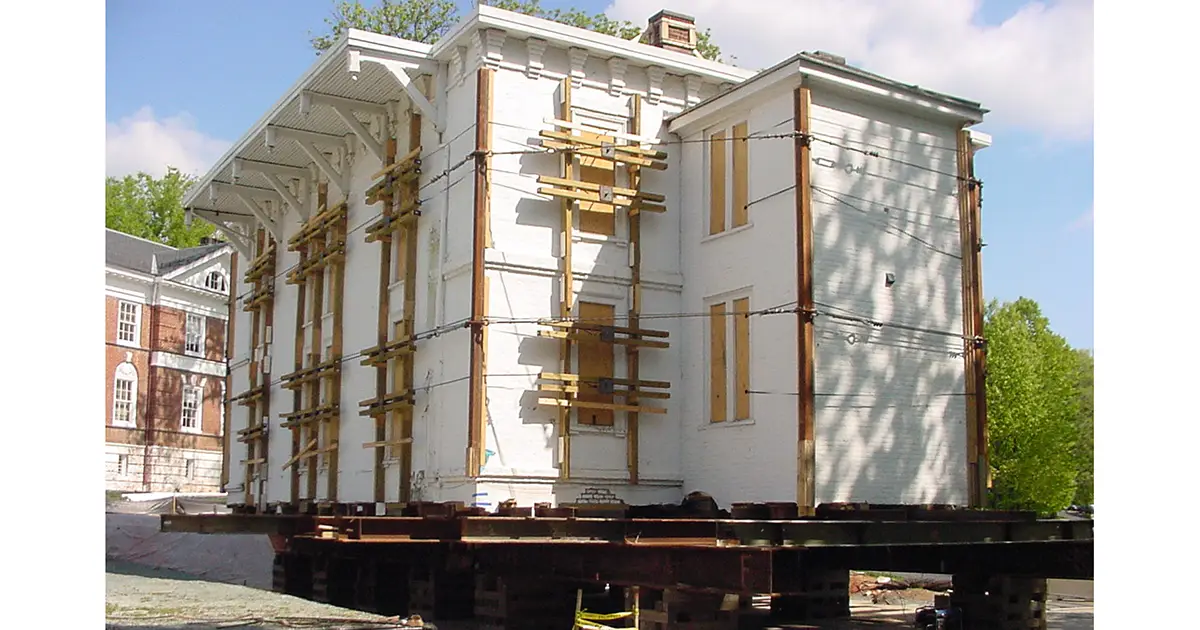
In the early 2000s, Varsity Hall sat perched on a hillside southeast of the Lawn, out of sight and out of sync with its surroundings.
“It was a building everybody kind of loved to hate,” says Mary Hughes (Arch class of ’87), who served as UVA’s landscape architect from 1996 until her retirement in 2022. “It was clearly a different style, a different era, was not even on the Jefferson grid of the rest of the Grounds.”
Built in 1858 as UVA’s first infirmary, Varsity Hall served in that capacity for 43 years, and then slid into obscurity over the next 100.
“It has survived because it was forgotten,” wrote the authors of a 2003 historic structure report on the building. “It is located out of sight, surrounded by other buildings constructed over the last century.”
It was one thing to be out of sight, and quite another to be in the way. In 2003, Varsity, then home to the Air Force ROTC, stood smack-dab in the path of a planned expansion of Rouss Hall, located directly to the west.
It appeared that Varsity Hall would have to be demolished, Hughes says. First, though, the building’s story needed to be documented, via that historic structure report.
The findings surprised almost everyone, Hughes says.
“Varsity Hall had this remarkable history nobody had even guessed at before,” she says. “It became impossible to justify tearing it down.”
With demolition off the table, only one option remained: Varsity Hall, so long neglected, was going for a ride, 185 feet downhill, to a new home on Hospital Drive.
At first glance, Varsity seemed an unlikely candidate for salvation. Written by John G. Waite Associates, Architects, the report began:
“A historic building is often considered worth saving if it is aesthetically important, or associated with a famous person. Varsity Hall falls into neither of these categories.”
Instead, Varsity Hall’s significance was as a rare surviving example of one of the first “modern” buildings, using the emerging technology of heating, ventilation and plumbing systems.
Designed by William Pratt, who was UVA’s first supervisor of buildings and grounds, Varsity Hall was the first purpose-built college infirmary on any American campus, according to UVA’s historic preservation framework plan. It owed its existence to the periodic typhoid epidemics that plagued UVA. Outbreaks in June and November 1857 resulted in the deaths of 19 students and the suspension of classes in the spring of 1858, according to “Varsity Hall: The Infirmary at the University of Virginia,” a 2008 article written in the Journal of American College Health.
The cause of the outbreaks was not known, although the miasma theory, widely subscribed to at the time, held that poor hygiene, lack of proper ventilation and stagnant water were culprits, the article said.
Accordingly, Varsity was built with an innovative central heating system, louvered and retractable windows that improved ventilation, and attic cisterns that collected rainwater runoff and piped it to the bathrooms. It integrated architecture and engineering in a way that made it a “state-of-the-art ‘machine’ for healing,” Jody Lahendro (Arch class of ’82), a retired preservation architect at UVA, wrote in an email.
Built in the Italianate style, it was part of a construction boom during a period of growth at the university. Varsity was also the first significant structure built off the Jeffersonian grid, not parallel to the Lawn. It was oriented to the northeast to capture the prevailing winds, Hughes says.
Students paid a $5 annual “infirmary tax” to cover the building’s operating costs and staff salaries. Though it is not well documented, it’s believed the infirmary was one of the UVA buildings co-opted for use as a Confederate hospital during the Civil War.
For several decades, Varsity sat alone. “Imagine Varsity as a freestanding building sitting in a sort of romantic landscape on a hillside,” says Brian Hogg (Col class of ’83), senior historic preservation planner for the Office of the Architect.
As UVA grew, the neighborhood got crowded. By 1899, Rouss Hall had risen to the west, Randall to the north and Cabell (now Old Cabell) to the southwest.
“The Lawn sort of turned its back on Varsity Hall,” Hogg says.
Soon after, Varsity lost its purpose. When the university hospital opened to patients in 1901, UVA no longer needed an infirmary. The “Old Infirmary,” as it was called in the early 20th century, became, in succession, a fraternity house, a home for nurses, a dorm for student-athletes (hence its renaming in 1919), a home for faculty, and finally, in the 1950s, the home of the Air Force ROTC.
Varsity Hall was still serving that purpose when the McIntire School of Commerce announced plans to expand Rouss Hall as part of the school’s move back to the Lawn. McIntire was not interested in incorporating the building into its expansion plans, Hughes says.
“At the time, the only history the UVA community valued was connected to Thomas Jefferson,” she says. “And this building clearly was not.”
Ironically, the fact that Varsity had been ignored for so long helped save it from demolition. Even so, contrary to appearances, it was not headed downhill before it was moved down the hill.
“Building finishes have been neglected for years,” the authors of the 2003 historic structure report wrote. “This has led to the erroneous impression that Varsity Hall is in poor condition.”
In fact, Varsity Hall was remarkably well-preserved. Though it had gotten ad hoc updates over the years, the features that made it historically significant—its original cast-iron furnace, wooden ductwork, freshwater cistern system, cast-iron kitchen stove, and four-track window and shade systems—were still intact.
The surprises that were revealed in the report on Varsity Hall raised the question of what other buildings might have been underappreciated, Hughes says. In 2006, UVA developed a Historic Framework Preservation Plan with the goal of taking inventory of the university’s entire post-Jefferson built environment. The plan, updated periodically, informs conversations about future development of Grounds by ranking buildings based on their contributions to the university’s history, the quality of their original design, their integrity and their current condition.
“The realization that we had this building that probably would be a National Historic Landmark on any other campus that was completely disregarded and planned to be demolished was a wake-up call that we should really look at a broader history of UVA and these buildings,” Hughes says.
Once it was decided that Varsity Hall had to move, the question became: Where? A site at the foot of Hospital Drive was chosen for its proximity, just 185 feet to the northeast. Moving the building farther away would have involved removing overhead utility wires, Hughes says.
Still, it was a massive undertaking, requiring months of preparation. Although the building was in good shape structurally, problems arose. The tower on the east wing was not attached to the main building, so the two pieces had to be cabled together. The windows had to be removed and the gaps between the walls filled with mortar.
The contractor, Expert House Movers, drilled holes in the building’s exterior walls, a few feet above the ground, and threaded heavy steel beams through them to support the structure from beneath. They then jacked the building 4 feet off its foundation and demolished the portion remaining below.
Workers slid 19 dollies beneath the building. Each had eight wheels powered by a hydraulic motor. The entire rig was operated by a joystick, says Expert House Movers founder Jerry Matyiko.
With joystick in hand, Matyiko got behind the building and began walking slowly down a gravel slope prepared for the building to descend on the morning of April 9, 2005.
Shortly after he started, the building began sinking into wet gravel. Workers put down wooden boards to provide better traction. Traveling the first 30 feet took three hours.
The pace picked up to a foot per minute before the wheels began sliding—and pulling the bulldozers anchoring the building from behind. Workers put chocks under the wheels to stop the building before setting off again, pausing every two feet.
Hogg was among those watching when the building finally rolled into place in the late afternoon.
“They had a plumb bob tied to one corner of the building to make sure it wasn’t tilting, and they had an X on the concrete where that corner of the building needed to land. When the plum bob was on the X, they stopped moving.”
The relocation was featured on an episode of the Discovery Channel program Mega Moves. When the building came to a halt on its new site, cheers rang out from spectators.
“It’s not going anywhere, anymore, nowhere for 100 years!” Matyiko said at the time.
Renovated after being relocated, Varsity is now the home of UVA’s Office of the Vice President for Research. A booklet in the lobby details the building’s defining features and 168-year history.
It’s a moving account.
We welcome reader feedback. Submit your letters to the editor here.