Style

Style Sunday August 23, 2026 Aug 23, 2026 28 articles
Quote of the Day
“The biggest adventure you can ever take is to live the life of your dreams.” — Oprah Winfrey
Virginia Living

How to Clean Your Diamond Jewelry and Restore Its Sparkle

Are your diamonds shining a bit less bright these days? This how-to from Woodbridge’s Chrysella Fine Jewelry will help restore their sparkle and protect them from long-term damage.

1. Mix warm water and a bit of dish soap in a bowl.

2. Soak your diamond jewelry for about 5 minutes.

3. Use a very soft toothbrush to gently scrub, focusing on areas where dirt and oil collect.

4. Rinse under warm water and dry with a lint-free cloth.

This article originally appeared in the Best of Virginia 2026 issue.

Continue reading →

Mental Floss

Trivia of the Day for August 23, 2026: 25 Questions and Answers for Curious Minds

It’s one of the last Sundays of August, and this day in history marks multiple important events. From the birth dates of influential cultural figures such as Gene Kelly and Shelley Long to the anniversaries of historical events like the executions of Italian immigrants Nicola Sacco and Bartolomeo Vanzetti, there’s a long list of significant happenings when you look back to the history books. Looking to test your knowledge of this day in history? You’ve come to the right place.

Continue →

Mental Floss

The Most Popular Movie the Year You Graduated High School

Film has certainly evolved over the past 50 years.

The special effects that captivated audiences in 1975's Jaws are a far cry from those in 2022's Top Gun: Maverick. Today, video and projection are digital, and computer-generated imagery (CGI) dominates the screen. Yet, these advancements don't make earlier films any less special; if anything, they make them more classic, though we appreciate the technological mastery of modern filmmaking.

Continue →

Style Weekly

Cellar Stories

Chrisa Giorgi's new wine documentary celebrates Virginia vineyards.

We’ve all heard about California wines, and many have heard of Oregon wines, but Virginia? Virginia wines have a bit of an identity crisis.

“I was in Minneapolis for a wine tasting,” recalls Luca Paschina, president and CEO of Barboursville Vineyards in Barboursville, Va.

Continue →

Mental Floss

6 Jobs People Were Doing in Pompeii When Mount Vesuvius Erupted

In the days leading up to Mount Vesuvius' eruption in AD 79, the people of Pompeii went about their daily routines, much as they would any other week.

Although tremors (which were not uncommon across the region given its tectonic setting) shook the coastal resort city, citizens paid little to no attention. Most ignored these warning signs and continued to frequent the taverns, main streets, and marketplaces as if nothing was amiss, until around noon on the day disaster struck.

Vesuvius sent rock and ash soaring miles into the sky. Debris blanketed the once-thriving city of Pompeii and buried residents within 24 hours. Even those who tried to escape met their unfortunate demise that day.

Continue →

Today in History
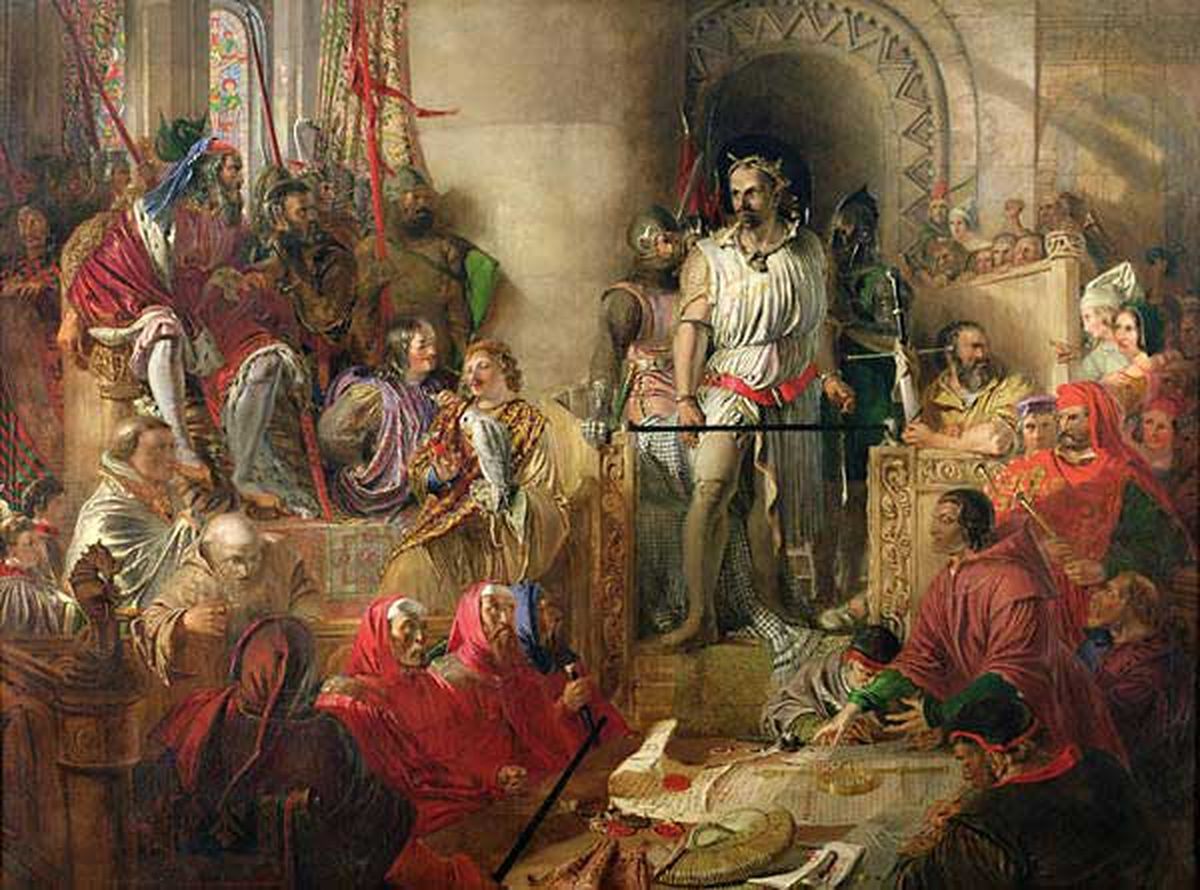
1305 · William Wallace Executed

1305 · William Wallace Executed

One of the great heroes of Scotland, William Wallace was one of the main leaders of the First War of Scottish Independence. In September 1297 he defeated the English army at the Battle of Stirling Bridge and was appointed the Guardian of Scotland, but was defeated at Falkirk in 1298. He resigned his post in favor of Robert the Bruce . Wallace managed to avoid being captured until 1305 when he was turned over to Edward I of England and he was put on trial for treason. To this charge he replied "I could not be a traitor to Edward, for I was never his subject." On August 23, 1305, he was stripped naked and dragged by a horse through London. He was then hung, drawn and quartered - strangled by hanging, but kept alive, emasculated, disemboweled and had his bowels burned before him, beheaded and then cut into four parts. William Wallace was portrayed by Mel Gibson in the Academy Award-winning film Braveheart , released in 1995.

Artist: Daniel Maclise Location painted: London, Kingdom of England Source: Wikimedia Commons

Mental Floss

10 Roaring Twenties Phrases You Use Everyday

In the early 1900s, a bizarre trend emerged in contemporary slang that saw anything or anyone particularly impressive described in the form “the something’s something.” This trend reached its peak in the 1920s, when phrases like “the clam’s garters,” “the worm’s ribs,” “the cat’s pyjamas,” “the owl’s bowels,” and—most notably of all—“the bee’s knees” all fell into use.

Unfortunately, only a handful of these have survived through to our language today, but happily these aren’t the only Roaring Twenties coinages you might find yourself unknowingly using in your everyday language.

Continue →

Mental Floss

The Railroad From ‘Stand by Me’ Has an Even Older Hollywood History

In 1982, Stephen King published a collection of four novellas under the title Different Seasons, which moved away from the horror writing for which the author had previously been best known. One of the novellas was titled “The Body,” and focused on the story of four friends going in search of the remains of a boy who they had heard had been hit by a train. It would later be adapted for the screen as the film Stand by Me, directed by the late Rob Reiner, and was released on August 22, 1986.

Continue →

Mental Floss

8 Sounds That Defined Saturday Mornings in the 1980s

The 1980s were a colorful, crazy time. Modern technological gadgets were all the rage, music was bright and brash, and so was the fashion. Day-Glo fabrics, big hair, and bold makeup marked the prevailing style. It was a decade of great change, and, for those who grew up during this time, the sounds on this list are sure to bring back vivid memories.

Continue →

Strange But True

Weekly Wrap Volume 74

Some people are into feet, others like dressing up in furry costumes, and a rare few will even get scatological (See: Mozart’s Much Less Family Friendly Works ). But when it comes to weird sexual practices, it would be difficult to top the mating rituals of the one-humped camel. Also known as the Arabian camel and dromedary, Camelus dromedarius is found throughout the hot, dry deserts of the Middle East and Africa (with a large wild population still roaming about in Australia as well). Unlike their two-humped… ( more )

If you’ve ever played Duck Hunt or any of the other NES games that used the NES Zapper gun, you probably at one point or another wondered how the game actually knows where on the TV you are aiming the gun when you pulled the trigger. It turns out, the method for accomplishing this is incredibly simple, as is the gun itself. This gun primarily just consists of a button (the trigger) and a photodiode (light sensor).  When you pull… ( more )

The first Earthlings sent into space were brave, calm under pressure, and heroic. They were also not human and many of them were furry. Yes, before Apollo 13, Buzz Aldrin, Neil Armstrong, and Yuri Gagarin, humans sent fruit flies, monkeys, and dogs into space to determine if living beings could survive the trip. These tests helped prove that, given a certain amount of precautions and protections, humans could endure space flight. Here is the little told story of these mostly cute and cuddly astronauts. The V-2 rocket developed by the… ( more )

While not thought to be directly related to modern Valentine’s Day traditions, the beginnings of celebrating love (of a sort) in February date back to the Romans. The feast of Lupercalia was a pagan fertility and health festival, observed from February 13th through the 15th, that was celebrated at least as far back as 44 BCE (the year Julius Caesar was assassinated). Some historians believe it goes back even further, though with possibly a different name. Connected to the Roman god Lupercus, (the equivalent to the Greek god Pan), the festival was originally supposed to be about shepherds and bringing health and fertility to their sheep and cows. When it became more ingrained into Roman culture, it additionally celebrated Lupa (also another possible reason it is named what it is), the she-wolf…( more )

Considering how most dogs in the Western world these days are treated as a member of the family, it’s often easy to forget that the vast majority of our furry friends up until very recently were bred for a specific purpose. Perhaps no dog was bred for a more specific purpose than the now extinct, turnspit. The turnspit was so named because it was literally bred just to run for hours on a tiny wheel that turned a spit. No, really, that was all it did. You see, a few hundred years ago the generally preferred method for cooking a large piece of meat evenly was to put it on a spit and rotate it until it was fully cooked. Cooking meat thoroughly on a spit takes anywhere between… ( more )

That Time Julius Caesar was Kidnapped by Pirates Who Demanded a Ransom of 20 Talents of Silver, but Caesar Insisted They Ask for 50

A 25 year old Julius Caesar was sailing the Aegean Sea when he was kidnapped by Sicilian pirates. The pirates who captured him initially asked for a ransom of 20 talents of silver (which is about 620 kg of silver or $600,000 by today’s silver prices). According to Plutarch, rather than send his associates off to gather the silver, he instead laughed at the pirates and demanded they ask for 50 (1550 kg of silver), as 20 talents of silver was too small of a ransom for himself. The pirates, of course, agreed and Caesar sent some of his associates off to gather the silver, which took 38 days to accomplish. Now nearly alone with the pirates… ( more )

Kentucky Colonel is the highest honor that can be bestowed by the Commonwealth of Kentucky. (Incidentally, if you’re curious: Why Colonel is Pronounced “Kernel” ) To be named a “Colonel” is to be recognized for “outstanding service to community, state, and nation.” The sitting governor of Kentucky, or the Secretary of State of Kentucky, are the only ones who can bestow such an honor onto an individual. These colonels are “Kentucky’s ambassadors of goodwill and fellowship around the world” and are “people from all walks of life.” Luminaries such as Muhammad Ali , Jim Beam, Fred Astaire, Betty White, and Winston Churchill are among… ( more )

When humans sleep, the muscles around our throats relax and cause the airways to narrow. Snoring occurs when certain soft tissues—such as the soft palate (or roof of the mouth), the uvula (the dangling piece of tissue at the top of the throat), elements in the nasal passages, or the base of the tongue—relax too much and partially block a person’s airway. As the body tries to breathe normally, the increased pressure in a person’s throat causes the soft tissues near the airway to vibrate. The amount of the airway that is blocked can determine the severity of the snoring, so the smaller the airway, generally the louder the snoring. Certain factors can increase the likelihood that a person, man or woman, might snore. For instance, snoring can worsen with age due to the loss of muscle tone. Similarly, being overweight causes excess fatty tissue on the neck to put… ( more )

Often used to accuse someone of exceeding his allotted level of funk, P.U. is, surprisingly, not an acronym, but, rather, likely was derived simply from the pronunciation of its parent word. Dating back to the early 17th century, a common exclamation of contempt for a foul odor was pyoo. As English spelling had yet to become standardized, this word was also written as pue, peugh, pew and pue. Although each variant was correctly pronounced pyü, often in practice, and particularly to express outrage, both syllables were stretched out with the pronunciation… ( more )

On an average day, a typical person’s nose will produce about one quart of mucus/fluid (just under one liter).  Most all of this snot generally gets passed back into your throat and swallowed, often without you even really being too conscious of it.  When you’re breathing cold air though, the rate of mucus production goes up significantly, causing some of that snot to come out the front of your nose, rather than back in your throat. What’s going on here is the blood supply to your nose actually increases as a response to the cold air, via tiny blood vessels in your nose dilating to increase the blood flow.   This helps keep your nose warm as you breathe, as well as begin… ( more ) a Why People on Planes and Ships Use the Word “Mayday” When in Extreme Distress

In 1923, a senior radio officer, Frederick Stanley Mockford, in Croydon Airport in London, England was asked to think of one word that would be easy to understand for all pilots and ground staff in the event of an emergency. The problem had arisen as voice radio communication slowly became more common, so an equivalent to the Morse code SOS distress signal was needed.  Obviously a word like “help” wasn’t a good choice for English speakers because it could be used in normal conversations where no one was in distress. At the time Mockford… ( more )

Weekly Wrap Volume 74
Now I Know

Boys Go to College to Get More Knowledge

A daily dose of fascinating

I ran two re-runs this week and will have two more next week — and I figured I’d share why I’m taking this time off. When I started Now I Know sixteen years ago, I was the father of two young boys. Now, I’m the father of two college-aged boys and a high school-aged daughter. And this week and next, “college” has been the word of the week. My oldest went back to school yesterday and my middle one starts this weekend. My daughter is starting the tour process, too. In short, I’m unusually busy, although for only good reasons.

(A quick non-sequitur which obviously isn’t one: if you’re currently donating to support Now I Know , I really appreciate it!)

As you can imagine, this is a moment of pride for me. College is, increasingly, seen as a must-achieve credential, particularly in many communities like my own — so it was not really an open question as to whether my kids would follow that path. But all three of them have demonstrated the same intellectual curiosity and desire to be lifelong learners that I hope to foster both at home and via Now I Know. The world is a fantastically interesting place and we’re all fortunate to be part of it; if you keep your eyes and ears open, there’s always more to learn and discover. College is only one of many paths, but it’s also unique — they’ll never have another opportunity to just go somewhere and learn, formally and informally, without the realities of the rest of the world interrupting every day.

If you’re at that stage of your life, don’t take it for granted. And if you have a loved one who is entering or in college, encourage them to embrace the opportunity. And in case my kids read this newsletter, we’re all in your corner. Be safe, have fun, learn a ton, and don’t tell me about the stupid stuff you do — we’ve all done it, and I don’t need the stress. And if things go wrong — and they will — we’re here to help.

Monday : The President that Fleeced the Country : This is about sheep, not corruption. Tuesday : Don’t Use This “Random” Password : The password is “ji32k7au4a83” and if you’re using it, you should change it immediately. Wednesday : How Baseball Closed Its Tiny Loophole : A belated happy anniversary to the most ridiculous thing to ever occur in Major League Baseball — well, a top 10 most ridiculous thing, at least. Thursday : A Chicken &*#! Tax Policy : A tax break for chicken stuff? You betcha.

Here are a few things you may want to check out over the weekend:

1) “ Why did we wait so long for the bicycle? ” (Roots of Progress, 11 minutes, July 2019). This isn’t a new article and I have a nagging feeling that I’ve shared it before, but whatever, it’s been seven years. It asks a very interesting question — the modern bicycle wasn’t invented until about 150 years ago, but humans knew enough about mechanics and physics and the like to have invented it decades if not centuries beforehand. What took so long?

2) “ The Grate Cheese Robbery ” (Longreads, 17 minutes, May 2026). Organized crime loves cheese — stealing it, mostly, but probably eating it, too. Why? (The “stealing it” part, not the eating part — that I get.)

3) “ Inside the World of High-End Matchmaking ” (New York Times/gift link, 17 minutes, August 2026). The subhead: “As he looks for The One, Joseph Pascaretta is investing in pricey matchmaking services. Will it help him find love?” I predict this article will demonstrate that Betteridge’s law of headlines also applies to subheads.

Arts & Design

The Art Newspaper

New documentary focuses on traditional crafts around the world and the pressures facing artisans

A large, deep-blue marble plate with 5,000 inlaid stones sits in Irfan Ali’s workshop in Uttar Pradesh, India. Ali’s family has practiced marble-inlay work (pachchikari) for generations. His ancestors likely even worked on the nearby Taj Mahal. Ali is one of only a handful of masters of the technique in the city of Agra. The intricate floral inlay took more than three months to complete.

Continue reading →

Colossal

‘Stories in the Seams’ Showcases the Enduring Legacy of Black Quilts Across Centuries

From the late 18th century through the end of the Civil War, the Underground Railroad was a network of safe houses where freedom-seekers from the South could find safety and shelter as they traveled north, sometimes all the way to Canada to escape capture and prosecution. It’s possible that there may have even been a secret code in the shapes of quilt blocks, which when arranged or displayed in a certain way could have helped direct people to stops along the route. This has never been confirmed with solid evidence, but even if it’s a thing of legend, the folk narrative is a powerful instrument for meaning in the oft-erased history of African American experience.

Continue →

The Art Newspaper

‘Race against time’ to rescue Alabama Civil Rights landmark

The Edistone Hotel has stood in downtown Selma, Alabama, since 1855 witnessing the tides of history, from slavery to the Civil War to the Reconstruction era to the Civil Rights Movement. In the late 20th century, it was closed and neglected amid the loss of many of the city’s industries and the decline of its population. The three-storey brick building with its boarded-up windows seemed to await the inevitable wrecking ball, until this past autumn when its acquisition by the Conservation Fund was announced.

Continue →

Colossal

Sift Through Grace Baldwin’s Giant Junk Drawer Filled with Nostalgia

We all have one, or at least some version of it: the junk drawer. Mine is a jumble of charging cables, old nails, a lanyard, matchbooks, a few key rings, scissors, an expired bottle of vitamins, every Allen wrench from every IKEA shelf I ever assembled, a few rubber bands, and frankly, who knows what else at this point. For artist Grace Baldwin, the junk drawer is a repository of memories and nostalgia, where common items end up in a place that’s simultaneously accessible and out-of-sight, out-of-mind. Lately, she’s been constructing a lifelike one at a monumental scale, drawer and all.

Continue →

The Art Newspaper

The Armory Show will launch two museum acquisition prizes at upcoming fair

The Armory Show will launch two new museum acquisition prizes at its upcoming edition (24-27 September), with the Pérez Art Museum Miami (Pamm) and the Bronx Museum each selecting a work for their permanent collections from the New York fair. These will be the first acquisition prizes in the fair’s more than 30 year history.

"These participating institutions and patrons share our commitment to fostering visibility, longevity and continued success, particularly for emerging voices and artists from across the Americas whose work sparks dialogue, challenges perspectives and contributes to the broader cultural landscape,” Kyla McMillan, the fair's director, told The Art Newspaper in a statement.

Continue →

The Art Newspaper

Collector couple to fund art history and AI fellowship at London’s Birkbeck

A high-profile collecting couple are funding a new postdoctoral fellowship in history of art and technology at Birkbeck, University of London, focused on artificial intelligence (AI).

The two-year fellowship—established by Anita Klesch and A. Gary Klesch, founders of The Klesch Collection—“supports pioneering research at the intersection of art history, AI and emerging technologies”, says a Birkbeck statement .

Continue →

Colossal

Damien Hoar de Galvan Puzzles Scraps of Reclaimed Wood for a Daily Sculpture Project

For many artists, designers, and writers, the daily project is a fruitful, if not invigorating, exercise. Whether it emerges in the form of a morning sketch or collection of objects gathered during walks, disciplined creativity has a certain allure, and many of us long for a regimen that pushes through blocks, demanding that we make even in the most uninspiring conditions.

Continue →

Colossal

Four Shortlisted Artists Stand to Win the Winston Taylor Photo Portrait Prize 2026

From nearly 4,000 entries submitted by 1,338 photographers around the world, a striking selection has been shortlisted for the Winston Taylor Photo Portrait Prize 2026. The handpicked images represent some of the finest photographic portrait work being made today, from intimate settings in which figures meet the viewer’s eye to candid scenes on city streets and rural expanses alike.

Continue →

Artnet News

Welcome to the World of Julio Torres and Martine Gutierrez

The best of Artnet News in your inbox.

The best of Artnet News in your inbox.

Julio Torres and Martine Gutierrez share a knack for building worlds and characters that operate on their own wonderful, absurdist logic. Throw them together, add some sea water, and you get Marina, their new performance commissioned by the Whitney Biennial.

The best of Artnet News in your inbox.

The best of Artnet News in your inbox.

Continue →

Artnet News

The Bill Blass Archive Has Finally Come to Market

Selections from the archive of groundbreaking American fashion designer Bill Blass are hitting the block for the first time ever this New York Fashion Week. In addition to its sale of outfits from The Devil Wears Prada 2 (2026), Christie’swill offer more than 100 Blass creations in an online auction titled “Bill Blass: American Elegance.” Bidding opens for two weeks starting September 9.

Continue →

The Art Newspaper

Newly discovered Bernini painting to be unveiled at Vienna museum

A newly discovered painting by Gian Lorenzo Bernini is to be unveiled in December at Vienna’s Kunsthistorisches Museum. Known primarily as a sculptor and architect, Bernini’s paintings are rare, with fewer than 20 accepted as authentic. He never signed his work, making attributions complicated.

The Vienna painting, Portrait of an Old Man, depicts the nearly life-size head and shoulders of an elderly man with dishevelled white hair, set against a dark background. His intense gaze is directed at the viewer, giving the work vitality. Until very recently, the museum attributed the portrait to an anonymous 17th-century artist working in Rome.

Continue →

Artnet News

The Other Anguissolas: Four Forgotten Renaissance Women Painters Take the Spotlight

There can be no doubt that Sofonisba Anguissola was a star of the Renaissance era. The Italian painter lived just shy of a century, and in that time won the admiration of Michelangelo, who offered mentorship in her early twenties, and a young Anthony van Dyck, who painted her in her late nineties. A celebrated member of the Spanish court, Sofonisba gained international renown for portraits that broke with stuffy formality in favor of a more tender vivacity. Her legacy was secured when Giorgio Vasari praised her talents “as a miracle” in his Lives of the Artists, one of art history’s foundational texts.

Continue →

Artnet News

Cult-Fave Art Space Blank Forms Is Getting a New Home in SoHo

Since 2016, renowned nonprofit art space Blank Forms has lain hidden away in a residential Brooklyn building. But, come fall, the venue will launch into its second decade with a move to Manhattan.

“Blank Forms really started out from nothing,” founder Lawrence Kumpf told me at his organization’s current home, split between a third-floor gallery and a first-floor concert space.

Continue →

The Art Newspaper

Comment | Kyiv must not let bureaucracy destroy the culture that Russian drones have already damaged

Before this becomes another story told too late, the Ukrainian government, Kyiv’s local authorities, the State Property Fund and the State Migration Service should intervene to protect the artist community Nahirna22. After surviving two Russian strikes, and raising money to repair the very building they were asked to keep alive, these artists were ordered to leave the Kyiv Institute of Automation. This is not a minor property dispute. It is a test of whether Ukraine understands that culture is not decoration in wartime. It is national security.

Continue →