The secret life of Grounds: From enslaved people’s quarters to steam tunnels, take a journey through UVA’s hidden spaces
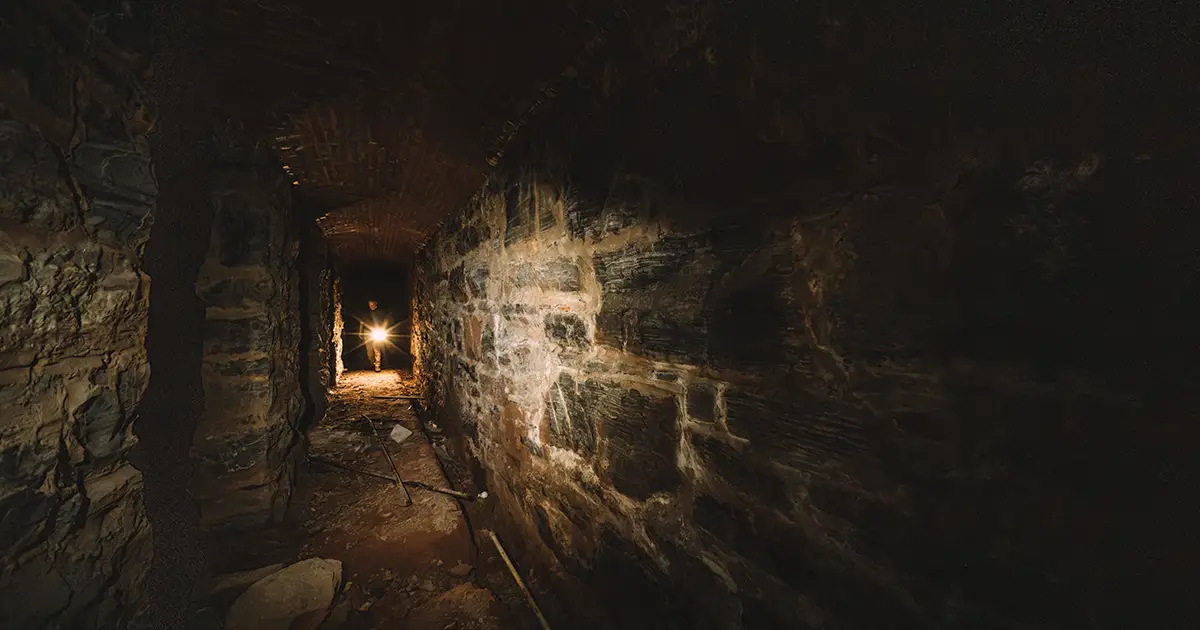
There are secret societies.
Hidden gardens tucked behind serpentine walls. Dorm rooms that date back two centuries. All add to the mystique surrounding the University of Virginia.
But on a quiet morning in late May, after Grounds had settled into its summer rhythm, Virginia Magazine was granted rare access to some of UVA’s most intriguing hidden spaces. Guided by assistant maintenance director Ryan Taylor (Engr class of ’99), we climbed into attics, ducked through crawl spaces and descended into tunnels that snake for blocks.
What emerged was a version of Mr. Jefferson’s university that few ever see. The tour connected places from different chapters of UVA’s story, from enslaved people’s quarters beneath the East Lawn rooms to the sophisticated book shelving system that powers today’s libraries.
For Taylor, a retired Air Force lieutenant colonel, maintaining these buildings means caring for more than bricks and mortar. The Academical Village, together with Monticello, is designated a UNESCO World Heritage Site for its exceptional significance to humanity. And tucked within its walls are countless reminders of the people who built and transformed the institution over generations.
As Taylor puts it, “They all have a story to tell.”
Furnished with wingback chairs and round mahogany tables, the middle gallery of Thomas Jefferson’s Rotunda is perched high above the Dome Room, offering students a secluded study spot removed from the daily bustle on Grounds.
Yet even this hideaway has a hidden room of its own.
Behind a locked door on the gallery’s north side, an attic reveals how the Rotunda has been built, and rebuilt, over time. Overhead, interlocking terra-cotta tiles installed by the R. Guastavino Co. after a devastating 1895 blaze form the dome’s fireproof roof structure. A makeshift closet opens onto the back side of the north portico clock, once driven by the intricate mechanisms of a timepiece made by Boston’s E. Howard & Co. The clock is now fully automated.
But the attic’s most compelling artifacts are not architectural. They are written on the walls.
Names, dates, quotations and confessions cover every surface. Some are neatly penned; others are hastily scrawled.
Brian Hogg (Col’83), the university’s senior historic preservation planner, says the probationary classes of the University Guide Service began sneaking into the attic and signing their names more than 50 years ago. During the Rotunda renovation completed in 2016, officials chose to preserve the markings rather than paint over them.
“It was known for decades,” Hogg says. “So it was kind of tacitly condoned.”
The inscriptions are as old as 1971 and as recent as 2025. Some are earnest. Others are funny.
One beam bears a blunt reminder of the pandemic era: “F Covid-19.”
Another offers life advice: “Listen to more Mozart and don’t be an asshole.”
There’s even the cosmic: “I have seen it. UFO.”
From the East Lawn colonnade, Pavilion VI hardly announces itself. Like the other nine pavilions Jefferson designed to house the university’s original schools, it was once both home and classroom, with professors living upstairs and teaching below. Now it is the private residence of Vice President and Chief Student Affairs Officer Kenyon Bonner, off-limits to curious passersby.
But something magical sits just off the second-story porch: a former professor’s parlor wrapped in frescoes by Robert and Marthe La Montagne St. Hubert. The artists, painting directly onto wet plaster in 1929, created the murals as a tribute to the friendship between Jefferson and the Marquis de Lafayette, as well as the enduring cultural ties between France and the United States. At the time, the pavilion was home to the Romance languages department, and the room was dedicated to hearing oral doctoral examinations.
Today it feels more like a small European salon.
Overhead, The Apotheosis of Liberty opens the room to the heavens. Four rearing horses draw Liberty in a chariot while crowds celebrate below. On the north wall, visitors encounter the room’s centerpiece: The Last Meeting of Lafayette and Jefferson at Monticello. Beneath a canopy of trees, the two men embrace on Jefferson’s lawn, surrounded by family, children, admirers and a company of horseback riders.
Then comes the room’s final reveal. Behind a door, a portrait of the murals’ donor, Ormond G. Smith, appears inside a hidden alcove. Standing before shelves of books, he gazes calmly outward.
Bonner says he’s moved by the room’s beauty and ambiance but uses it only rarely—to read or meditate.
“Honestly, I don’t spend a lot of time in there,” he says. “I’m always worried about, like, eating some french fries and getting ketchup on the mural.”
Just steps from the stately elegance of Pavilion VI, a cramped cellar beneath Lawn Room 22 offers a stark reminder of the enslaved people whose labor both built and sustained the university during its first five decades.
The padlocked basement room measures approximately 10 by 12 feet, with a ceiling so low that many adults could not stand upright. Pipes carrying electricity, water and steam line the walls and ceiling, delivering modern utilities to a historic footprint.
But before emancipation in 1865, those essential services depended on enslaved laborers, who tended fireplaces, hauled water and conducted other critical tasks. A 2024 historic structure report identifies the space as one of four cellar rooms beneath the Lawn that were used as living quarters.
More than 4,000 enslaved adults and children are believed to have worked at UVA starting in 1817, when they were brought to Charlottesville to build the Academical Village, according to the 2018 report by the President’s Commission on Slavery and the University. After students arrived in 1825, enslaved people were relegated to basements, attics and garden outbuildings, where they labored largely out of view, according to the report.
The room itself offers clues to its former use.
A small fireplace remains covered with whitewash, Taylor notes. The mixture of water and slaked lime was used at the time to disinfect, brighten dark interiors and control pests.
The fireplace under Lawn Room 22 also remains partly blackened with soot, evidence of years of use, Taylor says. Nearby, traces of a baseboard sit atop the dirt floor.
In the cellar room next door, the remnants of a brick cistern are visible, likely used for firefighting.
And just a few steps to the south, two other basement spaces have a more intimate connection to students today: They serve as communal bathrooms.
It might be easy to assume something mundane is stored in the gray cinder block warehouse in the 2400 block of Old Ivy Road—plumbing supplies, office furniture, rows of surplus equipment?
But the reality is more surprising.
This is Ivy Stacks, a high-density repository where millions of books, manuscripts and other library materials are shelved and retrieved for readers across the university. It contains a bibliophile’s paradise but is accessible only to a small cast of librarians who keep its towering 35-foot shelves in motion.
Built in 1994 and expanded in 2017 to accommodate collections displaced during the renovation of then–Alderman Library, Ivy Stacks now holds some 3.5 million items, from bestselling novels and 19th-century encyclopedias to hard-to-find vinyl records. The collection is stored in acid-free boxes and kept at a brisk 50 degrees.
When a patron requests a title, colossal shelves slide apart at the push of a button, opening to form a narrow aisle. A librarian uses a cherry-picker forklift to retrieve the volume, and the item typically arrives at the designated UVA library within 24 hours.
In an increasingly digital world, print collection strategist Caleb Mechem says UVA’s effort to preserve books is about more than safeguarding the words they contain. The objects themselves tell a story about the university’s evolution.
“They give us an insight into what was important to the university, and to faculty and researchers, over the years,” he notes. “If we didn’t have Ivy, we would have discarded all that long ago.”
Inside Cocke Hall, students spend their days studying ancient civilizations, classical languages and mythology.
But hiding in a cramped attic is a relic from a more recent era: a rare impulse tower clock whose original electrical system once kept time throughout the building.
Manufactured by the Standard Electric Time Co. of Springfield, Massachusetts, and given to the university in the 1920s, the timepiece was part of a synchronized network. A master clock elsewhere in the building sent electrical impulses every minute to secondary clocks throughout Cocke Hall, releasing their motor brakes for precisely eight seconds—just long enough for the hands to advance one minute before locking again.
At some point, the clock, which overlooks the McIntire Amphitheater, was converted to run on its own, a change that proved problematic. The clock eventually stopped working and remained that way for decades.
Restoring the clock began after Charles P. Cocke (Com class of ’65) attended a 2005 lecture by former university conservator Mark Kutney about the refurbishment of the building named for Cocke’s ancestor, John Hartwell Cocke. Charles and his wife, Betsy, funded the project.
Kutney recovered many of the original components in the attic and enlisted antique clock expert Robert Desrochers of Lititz, Pennsylvania, to restore them. After six months of refinishing the mechanism and the bronze clock face, the tower clock was returned to service with a newly created quartz master clock.
Today, workers have to crawl under structural beams and around HVAC equipment to get a glimpse of the clock’s whirring brass gears.
Facilities manager Dave Roberts was responsible for keeping the clock in working order until his retirement in 2024. In a recent university video, he revealed his simple approach: “We just treat it with a lot of love.”
Cameron Ratliff shimmies sideways between two 18-inch water mains, head ducked, eyes tracing the tangle of conduit overhead.
This subterranean maze is his domain. But even after years working underground, some corners still unsettle him. Take, for instance, the “Jesus mural” under Thornton Hall.
“It’s creepy, to be honest,” says Ratliff, associate director of utilities. “If you’re at the other end of the tunnel and can see that mural from a distance, it really looks like a person.”
The graffiti portrait—complete with its own Bible verse—is just one curiosity hiding in the more than seven miles of utility tunnels that snake beneath sidewalks, roads and athletic fields. The passageways, some of which date back to the early 1950s, carry low-temperature hot water, steam and IT cables across Grounds. But the tunnels have long doubled as a forbidden playground for students determined to pry open utility hole covers and slip past padlocked gates.
“This is one of their bucket list items,” Ratliff says.
In a Reddit discussion last year, graduates from the 1970s and 1980s described marathon Dungeons & Dragons sessions in the steamy warrens. Others traded stories about hidden entry points and elaborate student-generated maps. Still others warned of increased security and safety hazards, like dangerous temperatures and asbestos.
For Ratliff, “steam tunneling”—as some ’Hoos call it—is just another day at the office, albeit one that occasionally includes evidence of an uninvited visitor.
“Graffiti and beer cans,” he says.
Ed Murphy (Grad class of ’93, class of ’96) unlocks a heavy maroon door in the basement of McCormick Observatory and navigates around stacks of boxes to a bank of metal file cabinets. He slides open a drawer to reveal hundreds of glass photographic plates, each tucked into a manila sleeve. Nearby are handwritten observing logs, precision measuring engines and yellowing notes pinned to bulletin boards—artifacts left behind by generations of astronomers.
“I’m afraid it’s pretty much a giant junk room,” says Murphy, a professor in the astronomy department. “But it has tremendous potential for someone interested in the history.”
Most visitors come to McCormick, now primarily used for teaching and public outreach, to see its 26-inch refracting telescope. When the observatory opened in 1885, it was the largest telescope in the United States and second-largest lens telescope in the world.
But what’s stored below, under lock and key, offers a window into the observatory’s biggest contribution to astronomical science: its parallax program.
Beginning in 1914, McCormick astronomers embarked on an ambitious effort to measure stellar parallax—the tiny apparent shift in a nearby star’s position as Earth travels around the sun. By photographing the same stars every six months, often for a decade or more, researchers could calculate their distances from Earth, a crucial measurement for understanding how stars are born, evolve and die.
After photographs were taken using the telescope, the glass negatives were brought downstairs, where astronomers, students and young female workers called “computers” spent years making painstaking measurements on specialized machines. By the time the program ended in the mid-1990s, McCormick had measured the distances to as many nearby stars as almost any observatory in the world, before space-based telescopes rendered the labor-intensive technique obsolete.
In addition to around 144,000 glass negatives, the basement still holds nearly every measuring device used to analyze those images, from the earliest machines installed in 1914 to a laser-powered instrument built in the 1980s.
Murphy says the fact that his predecessors were “pack rats” means McCormick may be sitting on a treasure.
“I think this is one of the most thorough collections in the world.”
Joel Jacobus has spent countless hours spelunking every corner of Old Cabell Hall. A self-appointed steward of the building’s history, he can readily recite the quirks of the vexing edifice, completed in 1898 as part of the university’s expansion after the Rotunda fire.
“We have three different seventh floors, which aren’t connected. Two different second floors—and one of them is only accessible through New Cabell,” says Jacobus, who manages event scheduling for Old Cabell’s 851-seat auditorium. “And if you are standing in the lobby, you are on the sixth floor.”
There’s the old gun vault once used by the ROTC. A basement crawl space filled with Cold War-era Civil Defense drums manufactured for fallout shelters. And an empty dressing room rumored to have hosted secret society meetings.
But the real attraction, Jacobus says, are the “secret sub-dungeons.”
We descend to a space that stretches beneath the building’s front lobby and porch, resembling an outdoor colonnade buried underground. It looks and feels like a basement, but it’s technically the fourth floor. Old Cabell is built into a hillside, Jacobus explains, and every level is above ground.
Stone walls line one side of the walkway, while a series of arched brick storage rooms occupies the other. Known informally as the “caves,” some serve as storage for the music department; others hold housekeeping supplies.
Inside one of the chambers, Jacobus lifts a small utility hole cover and peers in.
“Want to see that?” he asks.
The undercroft is his favorite part.
Below, the space is tight and windowless, with a dirt floor and stone walls that echo the architecture above. There’s little evidence that students have ever found their way here, aside from a broken Coca-Cola bottle and a handful of initials scratched into the stone.
Then Jacobus notices something and chuckles.
“Don’t look at the booze bottles.”
We welcome reader feedback. Submit your letters to the editor here.