$34.3M Roman Marble Busts Through Antiquity Record at Sotheby’s
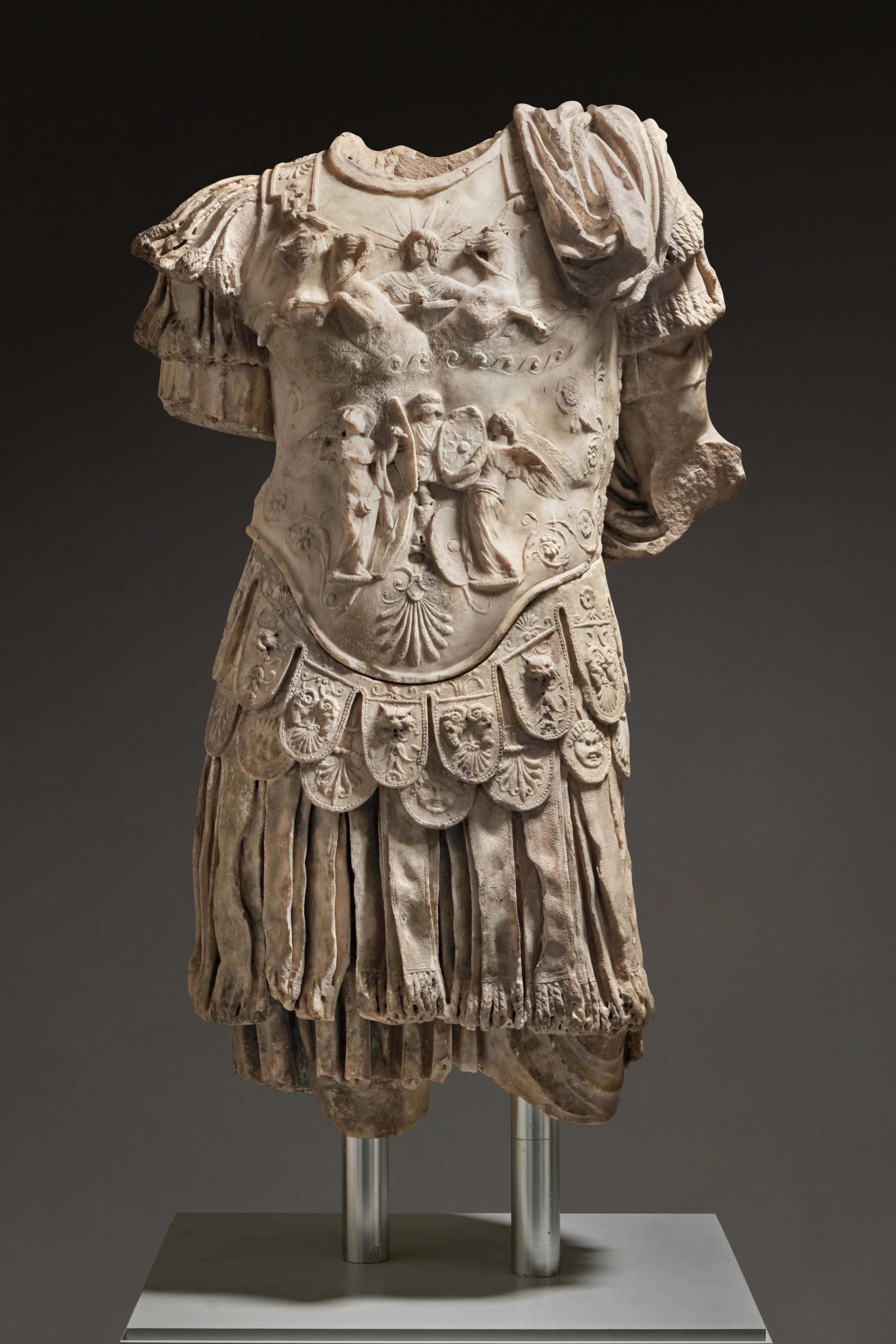
A marble sculpture depicting an emperor’s ornately armored torso, carved in the 1st century C.E., has become the most expensive Roman antiquity to sell at auction, realizing $34.3 million at Sotheby’sNew York on October 21.
The exquisitely detailed Roman sculpture was the marquee work in the first round of “Magnum Opus,” which saw all 64 lots sell for $63 million above a high estimate of $47.6 million. Overall, the single, unnamed collection will see more than 900 works, spanning 25 categories, arrive at sales in New York and Paris through 2027.
The best of Artnet News in your inbox.
The best of Artnet News in your inbox.
The oversized marble likely comes from the ancient Roman city of Salona, in modern-day Croatia, where it would have been displayed in a temple on the civic forum. Despite this provenance, the razor-sharp execution means it was almost certainly carved in Rome by expert sculptors of Greek origin—the stone itself has been traced to marble quarries on the Aegean island of Paros. The armor offers the emperor as a divinely sanctioned guarantor of universal order and the presence of the Roman sun god ties the work to the line of Augustus, well-known for leveraging such Imperial messaging.

Helena Newman fields bids in Sotheby’s Magnum Opus Evening Auction. Photo: courtesy Sotheby’s.
The torso flew past its presale estimate of $12 million across a 14-minute bidding contest between five collectors. The work was acquired by the seller for $7.4 million at Sotheby’s New York in 2010. Previous highs for Roman antiquities were a bronze depiction of Artemis and a stag, which sold for $28.6 million at Sotheby’s in 2007, and a marble nude of Aphrodite that netted $24.5 million at Sotheby’s in 2021.
“The result speaks to the extraordinary rarity of the work,” Margaret Schwartz, global head of European and Ancient sculpture at Sotheby’s, said over email. “Opportunities to acquire a Roman Imperial marble of this quality are exceptionally rare, and bidders recognized that this was a museum-caliber sculpture with outstanding provenance, remarkable preservation, and profound historical importance.”
The eclectic and geographically diverse sale brought Persian carpets, 18th-century French furniture, modernist sculpture, and Old Master paintings to the block in New York. The biggest outlier? A 1957 portrait of Marilyn Monroe by Richard Avedon, which met its low estimate of $100,000.
Floral Iznik pottery tiles from the second half of the 16th century were a strong performer. All four lots in the auction surpassed their high estimates. The pick of the bunch featured a cobalt-blue and turquoise triangular motif and fetched $204,000 above a high estimate of $180,000. “The strong performance of the Iznik tiles reflects growing appreciation for the finest examples of Ottoman art,” Benedict Carter, Sotheby’s head of Islamic and Indian art, said over email. “Collectors responded to their vibrant color, remarkable craftsmanship and rarity.”

Canaletto, Venice, View of the Grand Canal Looking East with Santa Maria della Salute (1740). Photo: courtesy Sotheby’s.
Canaletto’s Venice, View of the Grand Canal Looking East with Santa Maria della Salute (c. 1740), a typically precise and masterfully lit scene, squeezed past its low estimate to sell for $6.2 million. It was deaccessioned by the Metropolitan Museum of Art in 2020 and sold at Sotheby’s New York for $5.3 million.
A painting of oranges, cracked nuts, and wooden boxes by Luis Meléndez, the still-life master of 18th-century Spain, sold in the middle of its estimate range for $5 million. Jacob van Ruisdael’s View of Haarlem from the Northwest (c. 1670) went for $2.5 million.
Other antiquities also performed well, including a Greek bronze from the late 4th or early 3rd century B.C.E., which sold for $704,000 against a $500,000 estimate, and a late Hellenistic gold-and-emerald ring, which fetched $166,400, more than five times its high estimate.