It’s all fun and games: How four UVA alumni helped shape the “golden age” of puzzles. Plus: Play our three UVA-themed games.
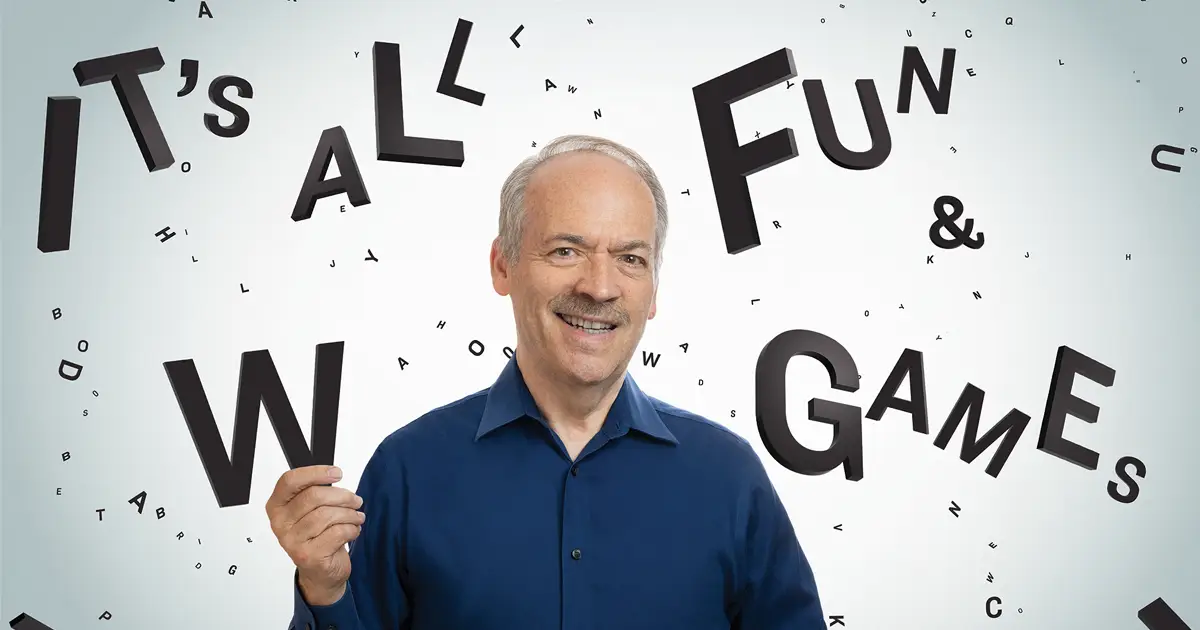
Shut off your alarm. Stretch. Solve the Wordle.
For millions of people around the world, playing a daily game is as integral to their morning routine as a cup of coffee or a slice of toast. Whether it’s Wordle, Quordle or even Octordle; the New York Times’ Spelling Bee, Connections or a mini crossword; games and puzzles are booming.
In 2025, players solved 11.2 billion New York Times puzzles, according to the company. Publications like The Atlantic and The New Yorker and tech companies including LinkedIn and Apple have launched their own digital gaming hubs in recent years.
Some of the most influential creators in the industry, including two New York Times puzzles editors, are UVA alumni. Four of them shared their thoughts with Virginia Magazine about why games are having such a moment.
The new games “show how we are living in the golden age of puzzles now,” says Will Shortz (Law class of ’77), the New York Times crossword editor since 1993 and the author or editor of more than 500 puzzle books. “I’d say there’s never in history been as much interest in puzzles as there is right now, and there’s more diversity and ingenuity in puzzles.
This period of puzzle prosperity has been building since the 1990s, Shortz says. Then, in October 2021, came the viral sensation that was Wordle, a daily game that gives players six attempts to guess a five-letter word. Two months after software engineer Josh Wardle launched the game, 300,000 people had played it, according to The New York Times. About three months after the launch, 1.3 million tweets about it had circulated.
In January 2022, the Times acquired the 3-month-old game for a sum “in the low seven figures,” the company reported. In 2025, it was played 4.2 billion times, according to the Associated Press.
A major reason behind the current popularity of puzzles, Shortz says, “is that more people nowadays are using their brains for a living than ever before in human history.” After work, your brain doesn’t shut off immediately, he says. It continues to crave stimulation, and the games available on our phones are a fantastic way to satisfy the craving.
Plus, today’s popular digital games offer a quick sense of satisfaction to even the busiest people.
“Most of the problems that we face every day in life don’t have clear-cut solutions,” Shortz says. “So when you’re solving a human-made puzzle and you fill in the last square or you solve it, you get a sense of finality that you don’t often otherwise in life.”
Such games also offer an incentive to keep coming back day after day to keep your streak extended, which is a new element in modern gaming, he says.
“Puzzles are the first thing that so many people in the entire world wake up and think about,” says Sam Ezersky (Engr class of ’17), the digital puzzles editor at The New York Times known for creating crosswords and editing the daily Spelling Bee word game.
Ezersky and Shortz are two of the seven full-time puzzles editors in the Times’ expanding games department.
“It’s fascinating to continue to build out this frame of reference, this mindset around just thinking about ways to entertain an audience with a daily diversion,” Ezersky says.
Now colleagues, Ezersky and Shortz met in 2016 when Shortz traveled to Charlottesville to deliver the commencement address at his alma mater, the UVA School of Law. (Though Shortz never entered the legal profession, he has “no regrets” about attending UVA Law and says it was “a good round of education” and “great training for the mind.”)
When Ezersky heard that Shortz would be on Grounds, he reached out in the hopes of connecting, unsure if anything would come of it. Shortz obliged.
“He bopped over to my house on freaking Shamrock,” says Ezersky, who, at the time, had just completed his third year in the engineering school and was creating weekly crosswords for the Cavalier Daily. He says that 2016 meeting with Shortz paved the way for his puzzle career.
Collin Waldoch (Com class of ’15) and Arthur Wu (Com class of ’16), the creators of the rhyming word game Twofer Goofer, also met at UVA. They knew each other through the “entrepreneurial scene” at the commerce school and kept in touch after graduation, Waldoch says.
In 2022, Waldoch, who had already created and sold a trivia company called Water Cooler Trivia with fellow ’Hoos Nick Jones (Com class of ’14) and Ryan Allen (Engr class of ’14), found himself inspired by the viral phenomenon of Wordle.
“Wordle was not some unbelievably unique gameplay mechanism,” Waldoch says. “It was just really, really well packaged, delivered, designed—a good piece of software for a really great core concept.”
The simple rhyming games Waldoch enjoyed as a kid inspired the concept for Twofer Goofer, which provides a daily prompt that challenges players to come up with two rhyming words. (For example: A flowing robe worn during stretching exercises? “Yoga toga.”)
Once Waldoch solidified the concept, he needed help building the software—and that’s where Wu came in.
“Arthur was a friend from UVA and a super, super talented designer that I’d kind of always wanted to work with,” Waldoch says. “I just needed a compelling enough pitch to get Arthur to join.”
Wu was on board right away.
“It just felt like a fun challenge,” he says. “A lot of software is confusing, but the beauty about games is that they should be playable by anyone.”
According to Wu, the pair “actually had no idea” if the venture would work. After many rounds of testing in Google Forms, they launched the game in August 2022 with the puzzle answer “glitter fritter.”
Over the next few years, Waldoch says, players around the world had solved Twofer Goofer puzzles a total of 2 million times. They sold the game to Merriam-Webster in 2024.
Both now work in tech—Waldoch as a product lead at a fintech startup and Wu as a co-founder of a software company—but maintain an appreciation for games and the value they bring to daily life.
“People are looking for ritual and looking for habits that feel good,” Waldoch says. “And I think puzzles just nail that.”
Plus, Waldoch says, games like Wordle, Connections and Twofer Goofer include built-in “share” buttons so players can easily relay their results to friends and family to keep in regular contact. That feature helps digital games “feel intimate and personal and social,” he says.
In a world where AI is being used to create everything from recipes to music, Shortz, who has worked in the industry for over three decades, isn’t worried about games and puzzles being outsourced to robots—at least not yet. There are programs that can create a crossword puzzle, for example, in a split-second, but it takes a human to come up with an original theme and playful, clever clues, he says. He’s seen people try asking ChatGPT or Claude to write an original clue for an answer, but so far he hasn’t been impressed by the results.
“It’s still a human activity, a human endeavor,” Shortz says.
The future looks bright for those looking to enter the puzzles industry, according to Ezersky, who has advised ambitious Cavalier Daily staffers on starting a dedicated puzzles desk.
“The average age of puzzle makers continues to get younger,” he says. “For a pastime that was always thought to be so guarded and erudite, it is almost—I’d say a good word for it—democratized.”
As someone who chose to pursue a career in the industry more than a decade ago, Ezersky has been thrilled to witness puzzles becoming a “widespread phenomenon,” he says.
“I used to just be a giant nerd all through my time at UVA,” Ezersky says. “And guess what? Puzzles are in fact cool and fun and, yay, more people than ever are playing them.”
These puzzle creators are dedicated players, too. We asked Shortz, Ezersky, Waldoch and Wu about their daily gaming rituals.
Self-proclaimed night owl Shortz notes that Wordle is released at midnight, so he plays every night at 12:05 or 12:10 a.m. Next he plays Strands, a twist on a traditional word search and his second-favorite puzzle of the Times lineup. Most days he plays a grid logic puzzle called One Up, created by his friend and colleague in Argentina, that gets larger and more difficult as the week goes on. “Then there’s a new one that was just brought to my attention that I’m crazy about called Ribbit that I’ve been doing every day,” Shortz says. (It’s an anagram game available to Puzzmo Plus subscribers.)
“I’m religious about my daily routine,” says Ezersky, who jokes that people accuse him of “insider trading” if he plays New York Times games, given his job as a puzzles editor. But he doesn’t work on Wordle or Connections—a category-matching game that is the Times’ second most-played after Wordle—so he gets to play those every day. Next he turns to a few non-Times games. “I’m a huge geography nerd. I play the Worldle, which shows a silhouette of a country, and you need to figure out what country it is.” Next up is the Globle, which requires players to locate a mystery country on a map. Also in his regular rotation: a word game called Quintumble and a fantasy football-themed game called Ultimate Roster.
Waldoch and Wu are a bit less rigid in their routines. Waldoch plays in a competitive online trivia competition called LearnedLeague every day when it’s in season. “It’s intense,” he says. “You have head-to-head matchups and all the former Jeopardy! players are in it.” Once or twice a week, he’ll also complete a mini or midi New York Times crossword. Wu also dabbles in the New York Times games—and mostly that means “trying and failing at Connections,” he says.
“School Break,” by Sam Ezersky
How many of these UVA words can you complete? Enter one letter per space.
We created a UVA-themed set of puzzles inspired by Twofer Goofer. Each answer will be a pair of rhyming words.
We welcome reader feedback. Submit your letters to the editor here.