Monet’s Long-Hidden ‘Iris’ Blooms to Record $56.2M at Auction
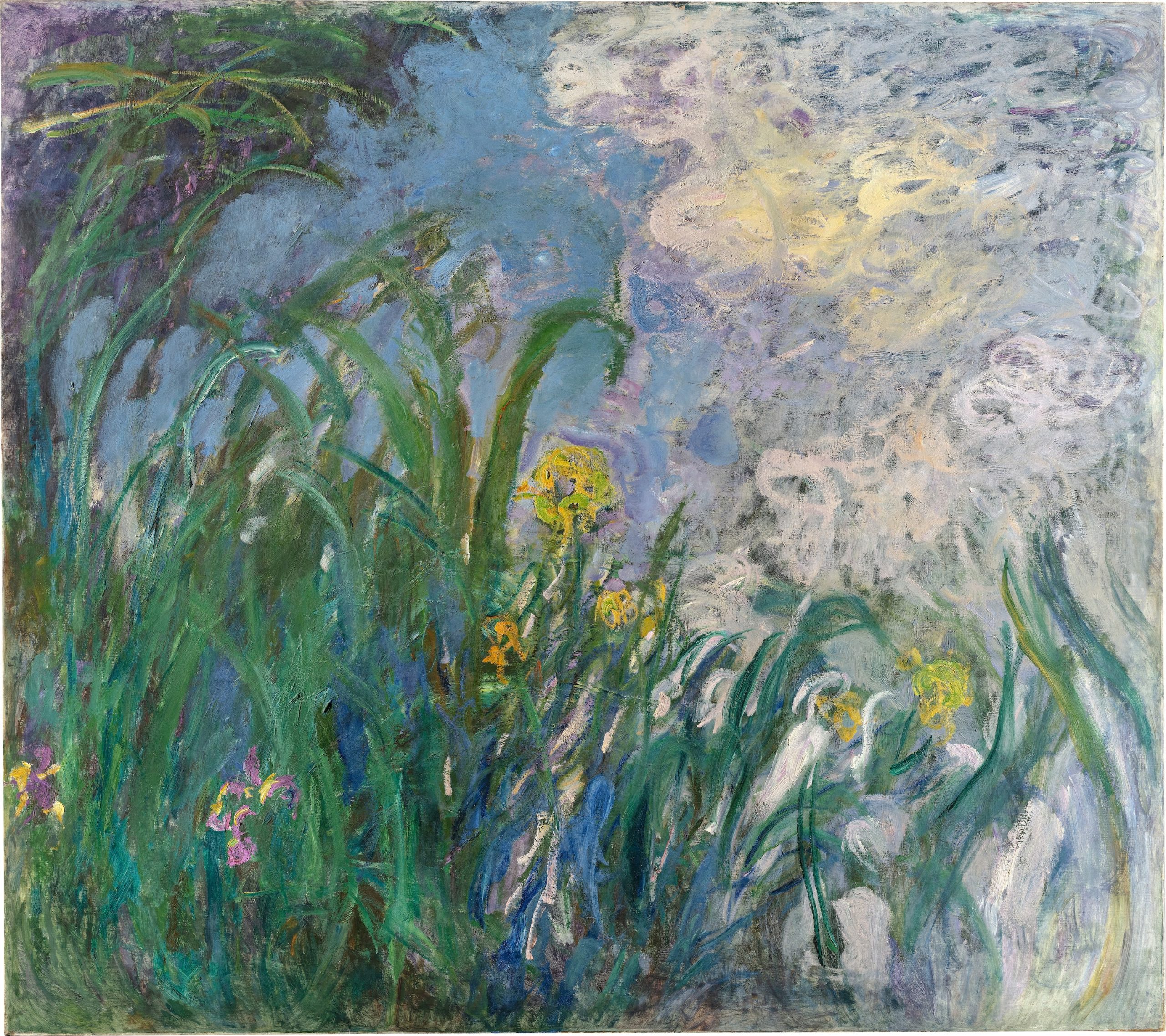
A long-unseen Claude Monet painting made history tonight in Paris, selling for €50 million ($56.2 million), more than double its low estimate, during Sotheby’ssale of the Schlumberger collection. It’s now the most expensive artwork ever sold at a French auction.
Iris (1924–25), which had never been exhibited publicly, is a monumental square, spanning nearly six feet across. It arrived on the block carrying an estimate of €22 to €30 million ($25 million to $35 million), the highest for a painting consigned at a French auction. On October 22, it prompted a 45-minute bidding war, with the winning bid going to a private collector in Asia. The final price surpasses the previous auction record-holder, Amedeo Modigliani’s Tête de Caryatide, which sold for €43.2 million ($48.4 million) at Christie’sParis in 2010.
The best of Artnet News in your inbox.
The best of Artnet News in your inbox.
“Six bidders, 45 minutes, €50 million, and a new record high for France,” Thomas Bompard, Sotheby’s France’s co-head of Modern and Contemporary art, said in a statement. “Tonight, Paris belonged to Monet.”
The work was one of three Monets from the Schlumberger trove—built up by Jeane Schlumberger, in consultation Parisian gallerist Katia Granoff—that hit the block. Two of these canvases sold within estimate: Saule Pleureur (1918–19), which went for €9.6 million ($10.7 million), and La Maison à Travers les Roses (1925–26), which fetched €2.5 million ($2.8 million). La Seine à Vernon, Arbres (1894), meanwhile, sold for €4.2 million ($4.7 million), more than doubling its high estimate.
Elsewhere, three early Paul Cézanne paintings were pre-empted by the town of Aix-en-Provence and the French Ministry of Culture. The works—La Ferme, Arbres au Bord de la Rivière, and Ciel Entre les Arbres—were created between 1862 and 1864 as part of a mural in the Jas de Bouffan, Cézanne’s family home in Aix. Now designated national treasures, the paintings will be acquired by the Musée Granet.
Records were also set for Pierre Bonnard, whose La Cueillette des Prunes (c. 1899) achieved €2.5 million ($2.8 million), and Gustave Moreau, whose Rêve d’Orient (1881) sold for €1.4 million ($1.6 million)—both marking the highest prices ever achieved by the artists at an auction in France.
In total, the white-glove sale of the Schlumberger collection brought in a whopping €74.4 million ($83.7 million), making it the most valuable fine art trove to ever cross the block at Sotheby’s Paris, with 74 percent of the works exceeding their presale estimates.
Inside the Schlumberger Trove
In 1956, the Granoff made an extremely bold move. Backed by the industrial fortune of Schlumberger, the Russian émigré acquired the studio holdings that Monet had left to his son Michel. This included a clutch of his late Giverny paintings, long overlooked as the messy flourishes of a master losing his eyesight. But where critics saw chaos, Granoff spied radical modernity. She was correct, of course. Monet’s irises, ponds, and water lilies foreshadowed and inspired the coming art of the 20th century.
“He painted a fragment of reality to give an idea of the immensity of the world. It’s not a description of a garden, but a world of painting,” Marianne Mathieu, a former curator at Musée Marmottan Monet and a leading expert on the painter, told me about Iris, the auction’s star. “Iris is an example of the ultimate work of Monet: to give a new definition of what painting must be.”

Claude Monet, Iris (1924–25). Photo: © Damien Perronnet, Blok Design Group & Art Digital Studio, Sotheby’s.
Monet’s attention to irises began with the onset of World War I, which forced the artist to retreat to his oasis in Giverny, leading to his now canonical investigations of color, light, and time. Forget water lilies—the iris was Monet’s favorite flower, one he depicted in around 20 canvases across two stints. This late iris is the culmination of a decade of Monet’s experiments. It dissolves the borders between objects and their reflections and uses scale to immerse the viewer, a move later echoed by the Abstract Expressionists.
According to the Artnet Price Database, the record for an iris-themed Monet is £10.8 million (roughly $24 million today) paid at Christie’sLondon in 2015. The highest price for a late work, however, is the €3.2 million (roughly $7.4 million today) paid for Iris Jaunes (1924 to 1925) in 2007 at Artcurial in Paris.

Claude Monet, Saule Pleureur (1918–19). Photo: © Eléa Lefèvre, Blok Design Group & Art Digital Studio, Sotheby’s.
The other Monet gem that sold at this auction was Saule Pleureur (1918–19), a fiery, all-over depiction of the weeping willow that stood at the north end of his water lily pond. It is, in a sense, two paintings in one: an abstraction capturing the atmospherics of his garden and a depiction of a tree amid a whirr of foliage.
It too was part of a series, one Monet considered a prime example of what contemporary art should be. In 1923, a curator at the Museum of Grenoble contacted Monet and asked for a sample of modern painting. Monet gave him Coin de l’étang à Giverny (1917), a work in the same mood and style as the Schlumberger canvas. “Standing in front of the painting, you are in shock,” Mathieu said. “You have the pure colors, put directly on the canvas without mixing on the palette, and the impasto that acts like a heavy skin. It’s an optical mix and it looks like an American abstract painting.”

Jeanne Schlumberger and Katia Granoff. Photo: courtesy Schlumberger family.
With Granoff’s help, the freewheeling Schlumberger built her collection over five decades beginning in the 1950s, displaying it in her family’s private townhouse. Where she held slightly unconventional tastes, collecting only French and 19th-century artists, Granoff preferred working with contemporary artists she could meet and champion.
The auction also offered a small but weighty cast of Camille Claudel’s La Valse (1895), her canonical depiction of dancers locked in an off-kilter embrace. There are several versions of the work—in some she toned down the nudity to appease social mores. This one offers more flesh and less drapery. It sold for €832,000 ($933,710) against a €400,000–€600,000 ($589,000–$688,000) estimate.

Camille Claudel, La Valse (1895). Photo: © Damien Perronnet, Blok Design Group & Art Digital Studio, Sotheby’s.
“It’s extraordinary how two women were so ahead of their time,” Bompard said over the phone. “Jeane Schlumberger was a bourgeoise grand dame living on the Left Bank, but she was quite wild at heart.”
This story was originally published on September 17, 2026. It was updated on October 22, 2026, at 4.00 p.m. ET, with the auction results.