It Takes a Village: Meet the ’Hoos helping ’Hoos find food, safety, confidence and community
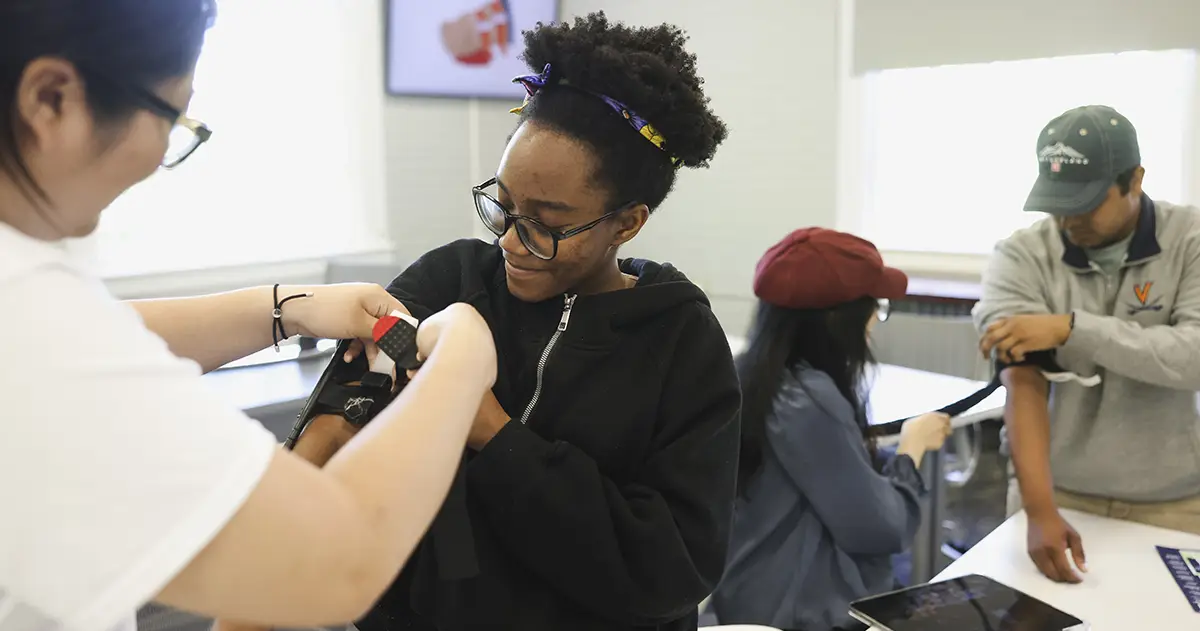
Like college students nationally, UVA students are arriving on Grounds with needs beyond some cheap late-night takeout or a ride to the Corner.
Rising living costs and wages that haven’t kept pace mean more people are stretching every dollar to afford basics like food, hygiene products or an interview outfit. For college students, that pressure can be especially acute—and it’s compounded for first-generation and low-income students, whose numbers are growing at UVA as part of a broader state initiative.
According to the State Council of Higher Education for Virginia, UVA aims to increase the number of students with income low enough to qualify for a Pell Grant to 25 percent or more by 2030. During the 2024-25 academic year, nearly 20 percent of undergraduates received the grant, up from 13 percent a decade before.
Mental health needs have grown more complex too. In the past decade and a half, UVA has expanded its clinical services, and visits to its mental health clinic have nearly tripled from 7,744 to 20,458, not counting virtual and group therapy—far outpacing the growth in student population.
Students and staff have responded. In 2021, the Student Council launched its Support and Access Services branch, which provides a range of support for students, including subsidizing textbook costs, providing emergency grants, and supporting an airport shuttle, among other services.
UVA also has centralized assistance called Care and Support Services, now housed in the Student Health and Wellness department. The office provides one-on-one guidance for students who need everything from a meal to peer connection or better study skills. Its basic needs programs have grown since the pandemic and include the Cavalier Food Pantry and a fund to help students cover unexpected expenses.
“We continue to attract the best of the best students from all backgrounds,” says Alex Hall (Col class of ’10, Educ class of ’24), an associate dean of students and director of Care and Support Services. “And in order to set them up for every type of success, UVA should be and is seeking excellence in all forms of support.”
As students increasingly feel the strain, they’re also stepping up to run or support programs that help their peers get by. Here are four examples.
The Cavalier Food Pantry, inside UVA’s Student Health and Wellness Center, is designed to feel less like a pantry and more like a supermarket with bright aisles, fresh produce, refrigerators and freezers, and hygiene items.
“It’s to make the students feel like this is just a normal experience,” says Nicole Pierce (Educ class of ’28), UVA’s basic needs program coordinator. “Food insecurity is far, far more prevalent on college campuses than anybody realizes.”
UVA doesn’t track food insecurity on Grounds, but nationally about 23 percent of college students experienced food insecurity in 2020, according to a 2024 U.S. Government Accountability Office report.
Generations of college graduates tell stories about surviving on ramen. But Pierce pushes back on the notion that it’s fine for college students to live on cheap, nutritionally poor food. “That is not a good diet, nor is that something we should be normalizing in any way, shape or form,” she says.
The pantry started as a Student Council initiative in 2018, opening inside Runk Dining Hall, in partnership with the Dean of Students office. When the pandemic hit and food insecurity was magnified, UVA gradually shifted the pantry from a student-run effort to a staff-led program under Care and Support Services with help from a student-led leadership team and funding from UVA. It’s set to receive the first $3 million of UVA’s $6 million Basic Needs Support Fund endowment campaign, now underway.
In the spring of 2025, the pantry expanded into a bigger space at the Student Health and Wellness Center while maintaining the Newcomb Hall location it had moved into earlier. Other UVA schools and departments, including the School of Nursing and the Women’s Center, also have their own food pantries.
Unlike the Newcomb location, the new space offers extended hours, full accessibility for students with disabilities and free parking. Students enter with their UVA ID.
About 80 percent of pantry visits now happen at the wellness center, and use of the pantry has surged. Annual visits have nearly doubled, from about 10,000 between July 2024 to June 2025 to 19,400 visits from July 2025 to May 2026.
The number of monthly visitors fluctuates, but an average of roughly 1,000 individual students visit each month, Pierce says. According to the pantry’s 2024-25 annual report, 52 percent work on Grounds, including graduate assistants and work-study participants.
Students line up to help. More than 200 volunteer as stockers, and available slots fill up within days, Pierce says. Daniel McCain (Col class of ’27) serves as the student leadership team’s head of marketing, running its social media strategy, partnering with groups on and off Grounds, and helping to coordinate fundraising events to drive donations and normalize pantry use.
He’s clear-eyed about what the growth means. “I am sad that this exists, and this exists at the scale that it does,” he says. “But in the face of hardship, community is such a beautiful way to be resilient and a way to remind all of us, whether it is just at UVA or it’s across Virginia or nationally, that we are stronger together.”
A job interview. A summer internship. A first date. Around Grounds, Micah Andrews (Col class of ’27) has heard the stories behind why fellow students wandered into the Cavalier Career Closet, which UVA’s Student Council opened in the fall of 2025 as part of its Support and Access Services branch.
Housed in Newcomb Hall and funded through UVA’s president’s office, the closet offers everything from suits and tuxedos to heels, blouses and ties for students who need to look their best.
Donations of gently used and new clothing have poured in from across Grounds and the Charlottesville community. Andrews, who served as the council’s chief of Support and Access Services last year, estimates they’ve received at least 3,000 donations so far. Students swipe their UVA ID to enter the closet and take whatever they need.
“It’s fully on their honor,” Andrews says.
The closet also operates online, partnering with MyCareerCloset to provide fully custom-fit new suits at no cost. Last year, the program funded 150 suits. The service is particularly helpful when the closet’s stock doesn’t include a student’s size.
Career closets are common on college campuses, run by student groups or career centers. At UVA, its goal is to remove barriers for first-generation and low-income students like her, Andrews says. “Things like this are exactly what I needed when I came to the university.”
A new student-run EMS agency on Grounds is in the works, a collaboration between UVA staff and premed students. The UVA Volunteer Rescue Squad, now in development under UVA’s Department of Safety and Security and in coordination with local EMS agencies, could launch in early 2027, with student EMTs stabilizing patients on scene before transport by an EMS agency.
“This is not being created because there’s a void of care,” says William Brady (Col class of ’84), a UVA professor of emergency medicine and medical director of Albemarle County Fire Rescue. “This agency is being created to help existing agencies that are already doing an excellent job.”
The idea grew out of CavsCARE, a student-run program that has delivered nearly 700 free certifications in three semesters for CPR, Basic Life Support and more. Kevin Omohundro (Col class of ’26) built it after noticing that affordable training wasn’t available to students.
“Lifesaving care is for everyone,” says CavsCARE president Ainsley Sadler (Col class of ’27), who has worked to expand the program to include other student groups, including Greek life.
After CavsCARE’s launch, Omohundro met with UVA Police Chief Tim Longo and Brady, and the conversation turned to expanding CavsCARE’s mission. The idea for a student-run EMS agency began taking shape, and Omohundro secured a $254,000 Jefferson Trust grant to kick-start the initiative. (The UVA Alumni Association, which publishes Virginia Magazine, also administers the Jefferson Trust.)
The concept isn’t new. The National Collegiate Emergency Medical Services Foundation counts more than 250 member programs. Virginia Tech’s squad, founded in 1969, answered 1,215 calls in 2023-24. Campus services average a 2.6-minute response time, according to one study, well under the national average of seven minutes.
“Even providing care within the first five minutes of a critical emergency will greatly improve the outcomes of any patient that we’re responding to,” says Connor Oakes (Col class of ’27), a leader in both the planned EMS and CavsCARE.
Beyond speed, organizers hope the squad eases students’ hesitation to call 911 and gives students with EMT certifications, who often struggle to find placements, the opportunity to help their community and earn clinical hours, which are important for medical school applications.
Omohundro won’t see the launch in person; he’s now attending medical school. But he planned for that. “We have succession planning for the next three years with very, very qualified students,” he says. “I’m very optimistic.”
In the first three weeks of her first semester, Katrin Bergesen (Col class of ’27) was rejected from every club she applied to. She felt aimless, but one place gave her footing: a one-credit class called Hoos Connected, built on research by UVA psychology professor Joseph Allen (Col class of ’80).
Once a week, Bergesen met with a small group of fellow first-years. Student facilitators guided them through team-building activities and then discussions about trust, conflict and communication. The class ultimately ended in a session where students could share something they had overcome.
The class “gave me the confidence to push myself through the rejection,” says Bergesen, a psychology major. “It gave me a platform to speak and recognize my own resilience as a person in a way that I hadn’t before.”
Hoos Connected, which annually enrolls about 900 undergraduates, grew out of a study Allen launched in 1998, tracking 184 individuals starting at age 13. It found that the quality of a 13-year-old’s best friendships predicted adult health outcomes better than any other factor.
The finding sparked a mission “to figure out what is happening when these relationships form organically out in the wild, and how can we take just a little bit of that magic and make it replicable, so that it’s accessible to everybody,” says assistant psychology professor Alison Nagel (Col class of ’10, Grad class of ’20), Hoos Connected program director.
Allen’s team first developed a high school program, now run nationally by the Wyman Center, a youth-focused nonprofit. That success led Allen’s team and UVA’s Counseling and Psychology Services program, with support from a 2018 Jefferson Trust grant, to adapt it for college students. By 2022, the program had evolved into its current form, with student facilitators. Other universities, including Virginia Tech, Georgetown and Northwestern, have since brought in UVA to implement the program on their own campuses.
Even before COVID, young people faced mounting mental health challenges, Nagel notes. Then the pandemic hit, amplifying anxiety and loneliness. Hoos Connected facilitator Nikita Majumdar (Col class of ’26) sees a lingering side effect. The trend of “protecting your peace,” which made sense during the crisis, left some students reluctant to engage with others.
Now, among peers, she sees a shift toward wanting to be part of a village—but building one takes a willingness to inconvenience yourself for others, says Majumdar, now the program’s full-time coordinator. “Hoos Connected teaches you the importance of being flexible with people and giving them grace,” she says.
Hoos Connected isn’t the only effort aimed at building connection between students. Flash@UVA is a student-run group that evolved from a 2011 program commissioned by UVA’s president’s office that featured small seminars. Today, Flash programs include acoustic Lawn concerts; speed-dating events; and the Strangers Project, where students pen anonymous letters about isolation, academic struggle or the bittersweet approach to graduation for others to read.
“A lot of the focus has been on this idea of unplugging or getting connected outside of the digital world,” says Flash@UVA president Cate Murcko (Col class of ’27).
For Bergesen, Hoos Connected helped her do just that. She’s still in touch with fellow students from that original class, and she became a facilitator. “Hoos Connected has watched me grow up in a way, which is really sweet,” she says. “It’s really made me feel like UVA is home and that I belong, but also that I have the ability to make other people belong.”
We welcome reader feedback. Submit your letters to the editor here.