This Kandinsky Work Is Primed to Shatter the Artist’s Record
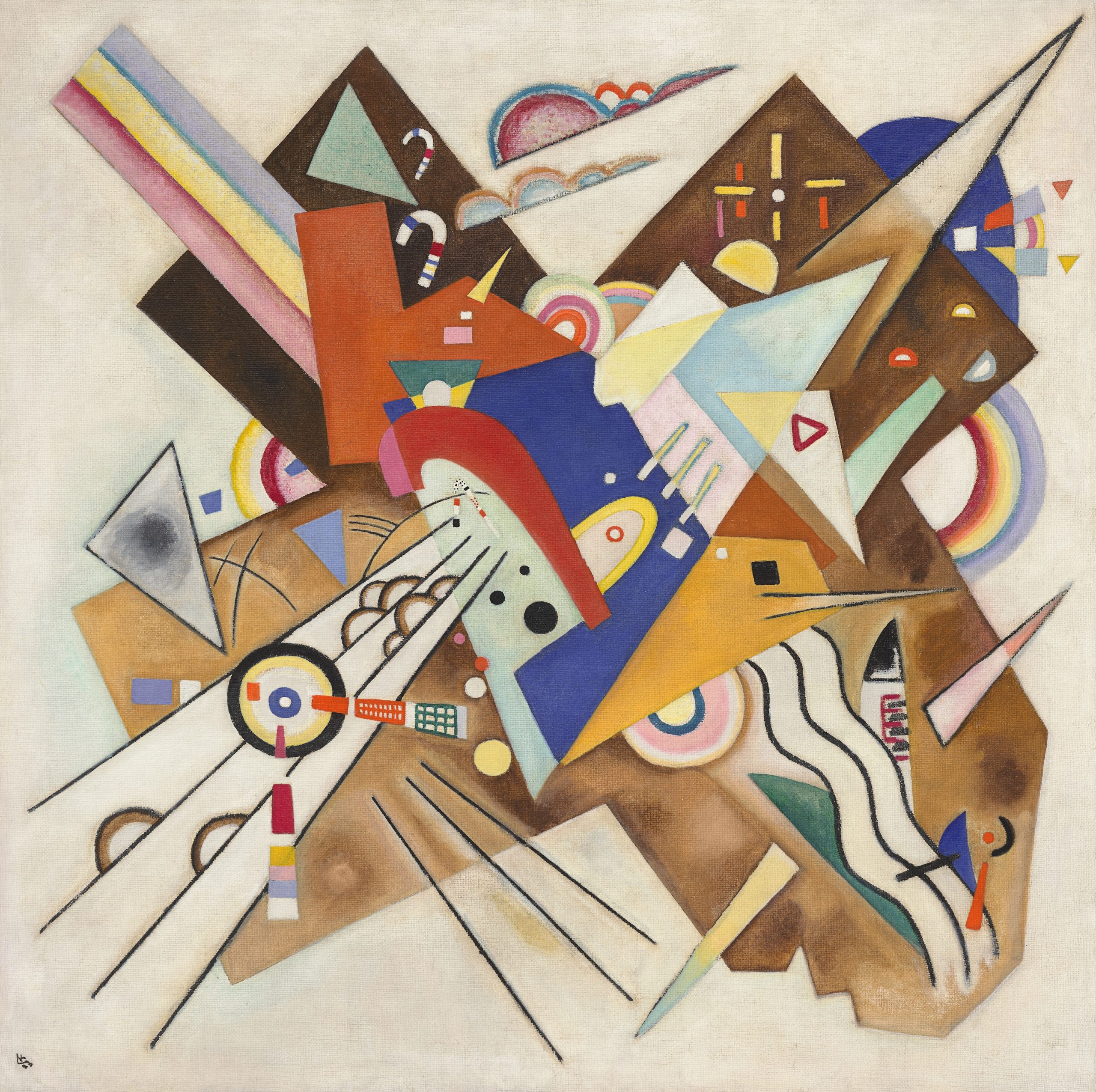
Wassily Kandinsky’s Betonte Ecken (1922–23) is tipped to make history at Christie’s20th Century evening sale in New York on November 17, where it could set a new auction record for the Russian painter.
A sale within its estimate range of $60 million to $80 million would far outstrip the current record holder: Murnau mit Kirche II (1910), which sold at Sotheby’sLondon for £37.2 million ($44.8 million) in 2023.
The best of Artnet News in your inbox.
The best of Artnet News in your inbox.
The work, whose German title translates as “Accentuated Corners,” was painted in Weimar shortly after Kandinsky joined the Bauhaus at the invitation of Walter Gropius. The group’s impact on the canvas is clear through its rigid geometries and the placement of primary colors. Another influence, music—most obviously gestured to in the painting’s black parallel lines—was more personal and deep-rooted. After attending a Wagner concert at the Bolshoi Theatre in 1896, Kandinsky envisioned a new art that merged music and painting. In time, he developed a theory in which colors possessed inner sounds: blue was akin to the cello and pure green to the calm tones of the violin.
In Betonte Ecken, Kandinsky attempts to paint musical melody, rhythm, and harmony onto a canvas organized by lines and two-dimensional shapes. The work is considered a direct forerunner of Komposition VIII (1923), a slightly more pared-back number that belongs to New York’s Guggenheim Museum.

The Bauhaus team in the 1920s (from left to right) Josef Albers, Hinnerk Scheper, Georg Muche, Laslo Moholy Nagy, Herbert Bayer, Joost Schmidt, Walter Gropius, Marcel Breuer, Wassily Kandinsky, Paul Klee, Lyonel Feininger, Gunta Stozl and Oskar Schlemmer. Photo: Getty Images.
“It is among his first Bauhaus masterpieces and is the best example from this seminal moment in his career to come to market in decades,” Paige Kestenman, co-head of Christie’s 20th century evening sale, said over email. “The estimate rightly positions the work to reset Kandinsky’s auction record.”
The painting, which emerges from an anonymous European collection, was the first Kandinsky work acquired by Hilla Rebay, co-founder and first director of the Guggenheim Museum (and a painter in her own right.) Her commitment to Non-Objective art had been shaped by Kandinsky’s treatise On the Spiritual in Art. In 1930, she finally met the artist in Dessau, where the Bauhaus had relocated in the face of political hostility. The Guggenheim acquired Betonte Ecken from Rebay in 1941 before selling it in the mid-1960s.
Betonte Ecken arrives at auction hot on the heels of Das bunte Leben (1907), an earlier Kandinsky work that blends Russian folk art with avant-garde sensibilities. The painting, the headline lot of Christie’s London 20th and 21st Century evening sale, achieved £31.6 million ($41.8 million), making it the third most expensive Kandinsky ever sold, according to the Artnet Price Database.